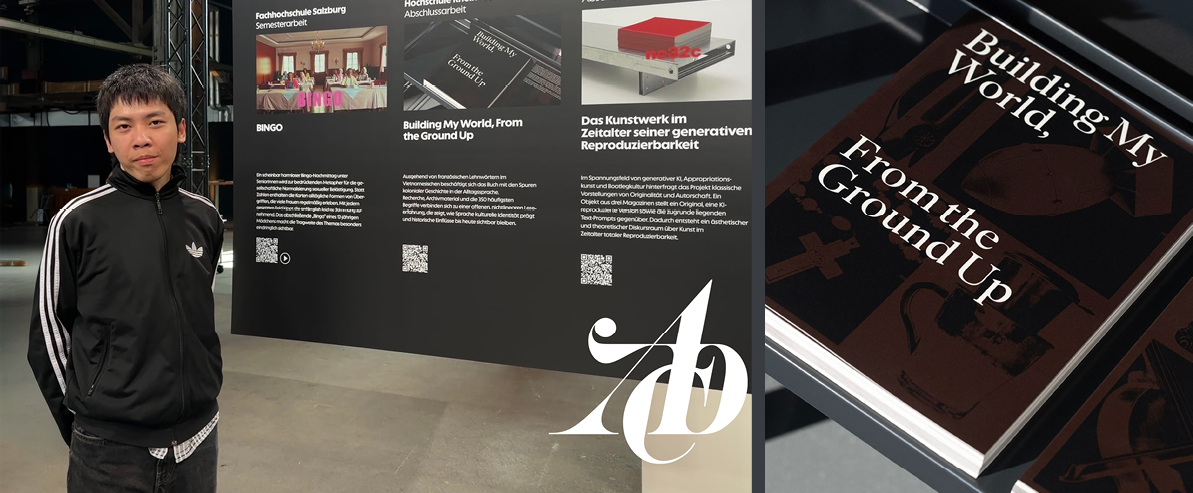
Oskar Phuong Nguyen was awarded a Golden Nail at the ADC Talent Award 2026 for his bachelor’s thesis ‘Building My World, From the Ground Up’. The thesis was supervised by Prof. Christian Stindl and Prof. Christoph Zielke.
The starting point for the publication is French loanwords in the Vietnamese language. Drawing on historical sources, archive material and the 350 most commonly used terms, Nguyen examines how French colonial history remains visible in everyday language to this day. Research, editing, typography and book design come together to create an open reading experience that brings language to life as a vehicle for cultural identity and historical memory.
The work exemplifies a core competence of communication design: researching complex social and historical contexts, reflecting on them critically and translating them into an independent visual language.
The ADC Talent Award is one of the most important competitions for emerging creative talent in the German-speaking world. The Golden Nail is awarded exclusively to works that set new standards through their conceptual and design quality.
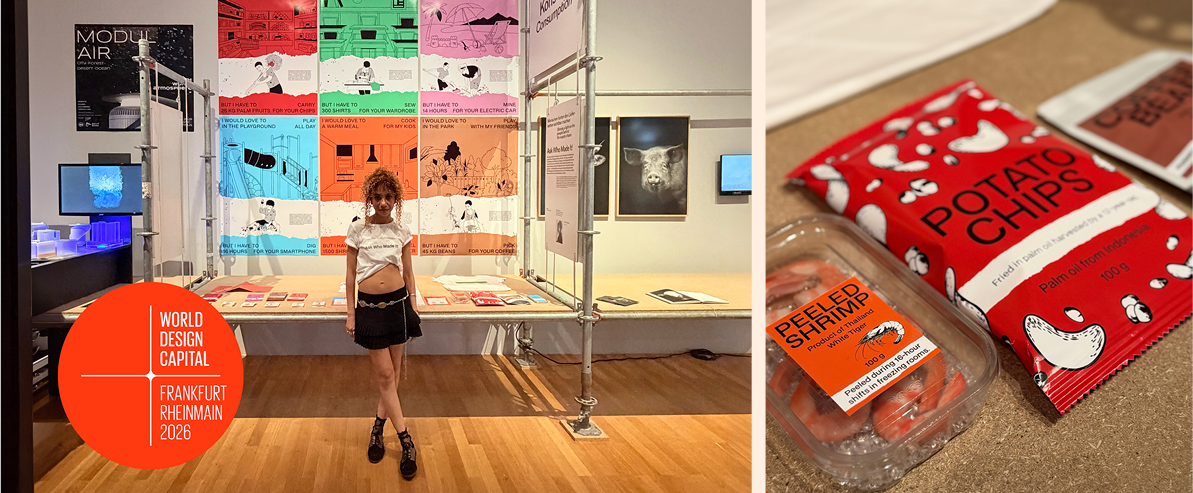
Back in 2025, Amal Hamed was awarded gold at the DDC Award for her Bachelor’s thesis ‘Ask Who Made It!’. The thesis was supervised by Prof. Nicolas Markwald and Prof. Christian Stindl. The cross-media campaign is now being presented in Frankfurt as part of the WDC Campus of the World Design Capital Frankfurt Rhine-Main 2026.
The World Design Capital title is awarded every two years by the World Design Organisation (WDO) to cities or regions that use design as a catalyst for social, cultural and economic development. Under the theme “Design for Democracy. Atmospheres for a Better Life”, the Frankfurt Rhine-Main 2026 region is presenting an international programme of exhibitions, projects and events. The WDC Campus brings together universities from Germany and abroad and offers up-and-coming international designers a platform for exchange and presentation.
Hamed’s campaign examines global supply chains across various industries, ranging from fashion and electronics to everyday products. Through in-depth research, interactive visualisations and a clear communication strategy, it highlights social and environmental interconnections and encourages people to question their consumption choices more critically. With the invitation to the WDC Campus, the project – which has already been awarded DDC Gold – will now be presented to an international specialist audience.
The project is on display at the Museum Angewandte Kunst in Frankfurt am Main until 9 August.
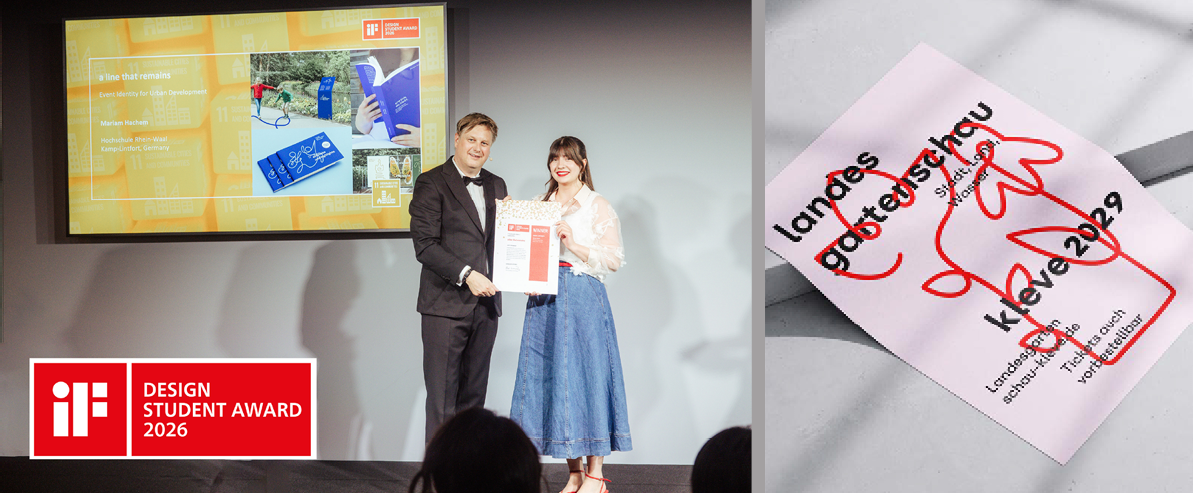
Mariam Hachem was honoured with the iF Design Student Award 2026 for her Bachelor’s thesis ‘A Line That Remains’. The award, presented by the iF Design Foundation, is one of the most prestigious international honours for emerging designers. More than 7,000 projects from 84 countries were submitted for the 2026 edition. The international jury selected just 90 projects from these.
The project arose from a collaboration between Rhein-Waal University of Applied Sciences and the city of Kleve to develop the future visual identity of the Kleve State Garden Show 2029. As part of a design competition led by Prof. Christoph Zielke, more than twenty students developed design concepts for the State Garden Show. Mariam Hachem’s design impressed the jury and forms the basis for the event’s official visual identity.
As part of her subsequent Bachelor’s thesis, Hachem further developed the design system in collaboration with Prof. Nicolas Markwald and Silke Gehrmann-Becker. Today, as a designer for the State Garden Show, she is overseeing the implementation of her own design concept. The project exemplifies how a student’s competition entry can evolve into a realised visual identity and how successful collaboration between the university and the region can be achieved.
A degree programme characterised by international exchange and social relevance
The three projects illustrate the thematic breadth of the Information and Communication Design degree programme. They address cultural identity, regional development and global responsibility, and demonstrate how communication design researches and analyses complex issues and translates them into compelling visual concepts.
At the same time, the projects reflect the profile of Rhein-Waal University of Applied Sciences and the degree programme. The Information and Communication Design programme is taught entirely in English and brings together students from numerous countries. The international academic culture opens up different perspectives on social issues and creates an environment in which academic research, conceptual thinking and design quality come together.
For Prof. Christoph Zielke, Programme Director of the Information and Communication Design programme, the recent successes demonstrate that this academic culture is reflected in the quality of the work: “Our students engage intensively with complex issues and develop independent creative approaches based on them. We are particularly pleased that this work is not only recognised in prestigious competitions, but is also gaining visibility beyond the university and having a tangible impact.”
Prof. Nicolas Markwald, Professor of Communication Design at the Faculty of Communication and Environment, sees the international composition of the student body in particular as a key strength of the programme: “When students from different cultural backgrounds work together on projects, questions and approaches to solutions emerge that extend far beyond national perspectives. The diversity of experiences not only enriches the exchange but, above all, shapes the topics being explored. Through close dialogue with the teaching staff, this gives rise to work that understands design as a means of communication, social engagement and cultural dialogue.”
These recent successes underscore not only the quality of the award-winning projects, but also the standing of the Information and Communication Design degree programme at Rhein-Waal University of Applied Sciences. The combination of an international academic culture, project-based teaching and close supervision creates an environment in which students develop work whilst still studying that garners national and international recognition and, at the same time, provides impetus for society, culture and the region.