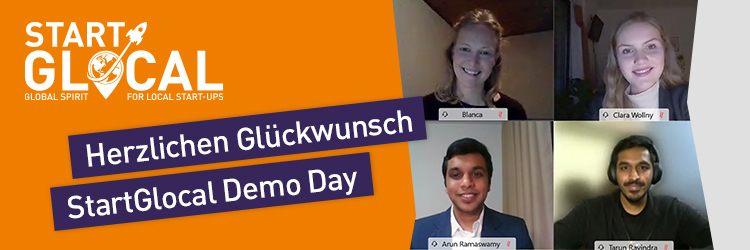
‘Demo Day’ is the closing event of the StartGlocal Academy, where students and alumni of the university gain expertise in setting up businesses. Following a ten-week workshop programme, all participants presented their product or start-up idea to an audience, who in turn selected the winners via a live vote. The winners are:
1st place: “Ways4Water – Floating Gardens” by Blanca Paschen (M.Sc. student in Biological Resources) and Francisco Javier Silva Deco (B.Sc. student in Sustainable Agriculture)
2nd place: “Cheetah – Electronic Vehicle” by Arun Ramaswamy & Tarun Ravindra (both M.Sc. students in Mechanical Engineering), a three-wheeled electric vehicle featuring smart tracking and fleet management, as well as a customisable cargo area for parcel delivery, designed to solve the ‘last-mile’ problem in parcel deliveries,
3rd place: “Mystery Travel – live adventure game”, a virtual and mystical puzzle-based travel game for all age groups by Clara Wollny (Bachelor of Arts in Sustainable Tourism).
© Paschen
‘Ways4water – Floating Gardens’ voted best idea
The student from the Faculty of Life Sciences came up with the idea for the ‘floating gardens’ whilst researching houseboats. She was looking for a solution to clean up bodies of water – a sustainable way to purify and restore the natural ecosystem: “Lakes become unbalanced when they are overloaded with nutrients. This can be caused by over-fertilisation of fields or the inflow of nutrients from sewage. As a result, algal growth is stimulated; when biomass decomposes, additional oxygen is drawn from the water, throwing it out of balance. My ‘floating gardens’ are designed to protect bodies of water from this. Enclosed within a hexagonal frame, the plants absorb the ‘excess’ nutrients (e.g. nitrogen or phosphates) and help restore balance to the water. ‘Equipped with water sensors to monitor water quality and a biomimetic propulsion system, the “floating gardens” are self-regulating and do not hinder boat traffic,’ says the student about her idea. The ‘floating gardens’ can be used in local water bodies, as well as in private gardens or on farms. Her idea is in the final stages of development and the Master’s student is now hoping to draw on engineering expertise for the practical implementation of her product concept.
Thanks to the supporting organisations
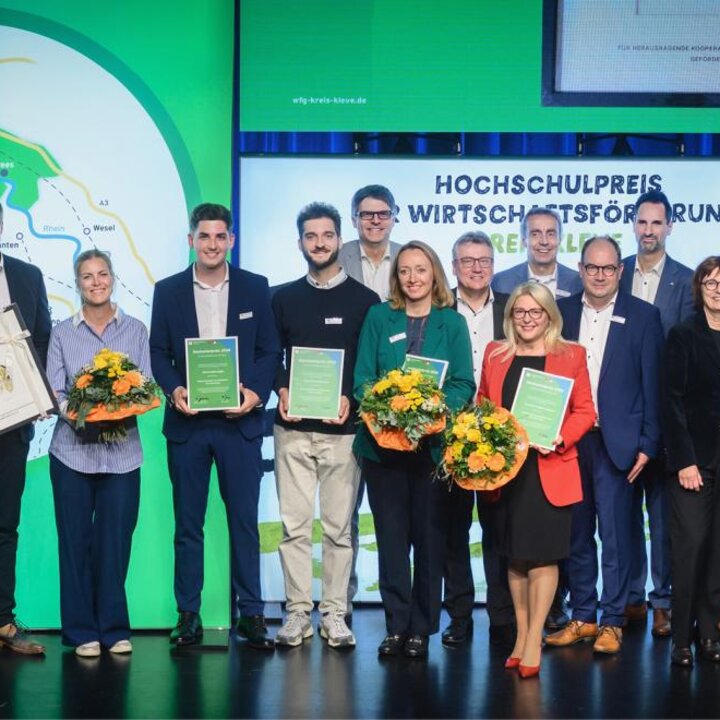
The top three places are awarded prizes of 300, 200 and 100 euros. The university would like to thank all StartGlocal Academy participants, the mentors and experts, and in particular the three supporting associations – Campus Cleve e.V., Campus Camp-Lintfort e.V. and the university’s own supporting association – for providing the cash prizes.
“StartGlocal – Global Spirit for Local Start-ups”
The “StartGlocal – Global Spirit for Local Start-ups” project has been funded since April 2020 as part of the EXIST programme by the Federal Ministry for Economic Affairs and Energy and the European Social Fund. Sustainability is the project team’s top priority: for every milestone in a project, a tree is to be planted as part of a ‘StartGlocal Forest’. “The issue of sustainability is of great importance in our StartGlocal project. It is very important to us to establish the university as an innovation partner for sustainability issues in the region, whilst at the same time involving our students and supporting their development,” said Dr Gerhard Heusipp, Head of the Centre for Research, Innovation and Transfer at Rhine-Waal University of Applied Sciences.
StartGlocal Academy
As part of the StartGlocal project’s “StartGlocal Academy” workshop programme, students and alumni of the university interested in starting a business were given the opportunity for the first time during the 2020/21 winter semester to acquire the basic know-how required to set up a start-up. In an interactive learning environment, the students were supported by experts and mentors from the start-up and entrepreneurship sectors. Over the course of ten consecutive online workshops, participants were taught all the key skills and processes essential for a start-up, including idea generation, business models, prototyping and, on a practical level, the legal and tax aspects of running a business.
The ‘StartGlocal’ project is funded by: