In collaboration with Kleve Vocational College in the district of Kleve, the Faculty of Society and Economics at Rhine-Waal University of Applied Sciences is, for the first time, offering a phased model for dual study programmes at the start of the training programme or the start of the winter semester 2021/22 on the ‘International Business and Management, B.A.’ for the first time, to coincide with the start of the training programme or the start of the winter semester. This model involves combining work in a company with attendance at the university and the vocational college in phases.
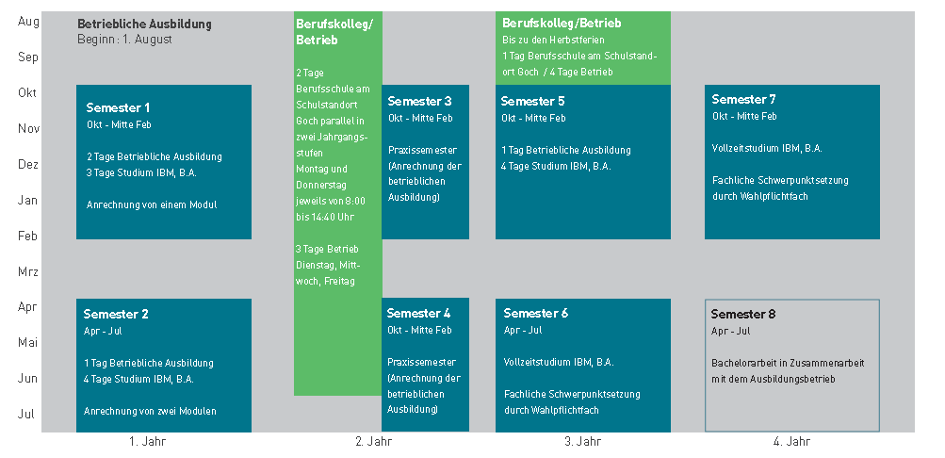
At the Kleve Vocational College in the district of Kleve, on the Goch campus, the vocational school component of the two-and-a-half-year dual training programme is completed in one-and-a-half years, leading to the vocational school qualification. The intermediate examination set by the Chamber of Industry and Commerce (IHK) takes place in late February or early March of the second year of training. In the third year of training, the vocational training to become an industrial clerk or a wholesale and foreign trade clerk – specialising in wholesale – is completed with the final examination set by the IHK, with the written examination taking place at the end of November and the oral examination in the second half of January.
A total of three modules (Introduction to Business Administration, Introduction to Law and Introduction to Accounting) are credited towards the ‘International Business and Management, B.A.’ degree programme upon successful completion of the vocational qualification. The degree programme concludes with a Bachelor’s thesis – the topic of which is determined in collaboration with the training company – and a colloquium following the 8th academic semester.
Goch Phased Model
Caption: Overview of the Goch phased model
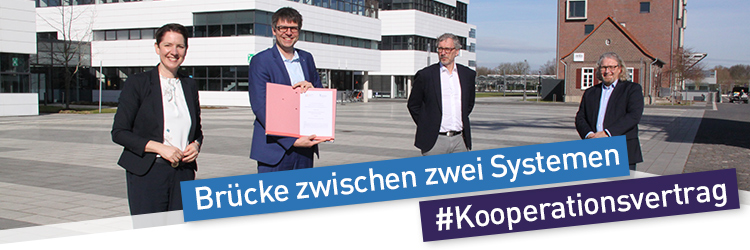
‘A bridge between two systems’
Dual study programmes have played a major role since the university’s founding phase, and cooperation agreements were established at an early stage. In the current consolidation phase, an assessment is being carried out to identify what is working well and what can be improved. In addition to future students and apprentices, “the local economy also benefits from partnerships such as these. For me, these graduates—who have combined a dual degree programme with an apprenticeship—are the ideal young talent for businesses,” says District Administrator Silke Gorißen, summarising the benefits of the cooperation agreement.
Peter A. Wolters, headteacher of Kleve Vocational College, is also delighted with the agreement: “We now have a very well-thought-out model that is affordable for students and apprentices and, above all, bridges the gap between two systems.” All those involved are now hoping to attract companies for whom this model is of interest. Professor Dr Ralf Klapdor, Dean of the Faculty of Society and Economics, is pleased that initial discussions with companies are already underway.
This is primarily an initiative for the region, designed to help ensure that companies have a supply of skilled workers. “We see ourselves as a university for the region, one that prepares students well for the start of their careers through practical elements. With a dual study programme, we are committed to fostering networking and connections within the region. And last but not least, particularly during a pandemic such as this, we offer graduates of this programme excellent opportunities to enter the workforce and contribute to the local economy. And thus, prospects for the future – for all of us,” says Dr Oliver Locker-Grütjen, President of Rhein-Waal University of Applied Sciences, summarising the partnership.
“International Business and Management, B.A.” degree programme
In addition to learning theoretical content in the fields of business administration, economics and management, students have the opportunity to put their knowledge into practice through numerous project-based assignments (including in collaboration with their training company).
As part of the degree programme, alongside the theoretical content, students not only acquire core competencies such as academic research methods and entrepreneurial thinking, but also develop soft skills, the importance of which is growing in the world of work. Through alternative forms of assessment, students improve their presentation and communication skills and learn about teamwork and conflict management. Thanks to the international environment at Rhein-Waal University of Applied Sciences and the English-language modules, students have the opportunity to develop extensive foreign language skills and an openness to other cultures.
Course on offer: International Business and Management (BA)
Entry requirements
For the dual Bachelor’s programme, applicants must, in addition to the standard entry requirements, have a training contract in one of the aforementioned professions with a training period of two and a half years. The forthcoming apprenticeship is generally recognised as the initial work placement. The dual study programmes at Rhine-Waal University of Applied Sciences are open to all applicants. Interested companies and/or prospective students are welcome to contact gesellschaft-oekonomie@hochschule-rhein-waal.de or the vocational college at KIBM@berufskolleg-kleve.de for further enquiries. The application deadline follows the university’s standard application deadlines; this is usually 15 July for the winter semester.
Kleve Vocational College
With 4,600 students across more than 60 courses, Kleve Vocational College is the largest vocational college in North Rhine-Westphalia. The diversity of its educational programmes is unrivalled and offers young people prospects – in line with the motto ‘Our diversity – your opportunity’. Here, young people are supported on their path to a professional future – whether through dual vocational training, improving their school-leaving qualifications, or through further vocational education and training. Pupils are able to develop their personal strengths and vocational qualifications to the full. In doing so, they benefit from the flexibility of the system, high-quality facilities and professional guidance. In addition, pupils acquire the skills to participate in and actively shape the increasingly international developments in business and society. That is why Kleve Vocational College works closely with businesses, chambers of commerce, associations, trade guilds, universities and other non-school partners in the Lower Rhine region.