Fashion Revolution Week 2026
From the collapse of the Rana Plaza to a global movement for change: Fashion Revolution Week shines a light on the hidden costs of fast fashion and the people behind our clothes. This tragic disaster has raised global awareness of the situation of the predominantly female workforce in the textile industry in the Global South and inspired people to get involved in the fair trade movement, with the aim of fundamentally improving working conditions. Since 2017 also in Hochschule Rhein-Waal students and staff have been promoting fair trade, ethical production, and sustainable choices through engaging student-led initiatives.
The Fashion Revolution week is a further development of the Fashion Revolution Day which reminds us of the breakdown of Rana Plaza in Bangladesh, the biggest accident in textile industry: In 2013, an eight-story building in Savar, near Dhaka, Bangladesh, collapsed. The industrial building, constructed in 2006, had five garment factories, a bank and apartments. The last four floors of the building were constructed without proper permission (Schwier n.d.) and the construction of a further floor had just began.
On 23 April 2013, large cracks were discovered in the building; the shops and the bank on the ground floor were closed immediately, but the garment factories ignored the warning and forced the workers, who were frightened by the cracks, to continue working and stay on site. On 24th April 2013, the whole factory building collapsed causing the deaths of 1134 people and about 2500 injured (Hoskins 2015).
But the Rana Plaza disaster was the deadliest accident, but not the only one. Six months earlier, for instance, a factory fire in Tazreen Fashions in Dhaka killed 122 people.
Inadequate workplace facilities and bad working conditions, as long work times can lead to fatal accidents, serious injuries or damage to health (Kabir et al. 2022). Long working times, poor payment and separation from their children are further problems the workers face (The Financial Express 2022). These affects workers in textile factories, not only in Bangladesh but also in other countries where there are no safety regulations or where they are weak, and where workers’ rights are not adequately protected.
The garment factories in Bangladesh and other Asian countries produce garments regularly for well known brands e.g. Benetton, Zara, The Children's Place, El Corte Inglés, Joe Fresh, Mango, Matalan, Primark, and Walmart.
But the biggest tragedy in the fashion industry till date exposing the hidden reality of fashion became a turning point for the global fashion industry in Bangladesh. The so named Bangladesh Accord was introduced with the target to improve the safety for workers in textile industry (Raina and Jennings 2023).
Famous companies as Carrefour, Benetton, Marks & Spencer, El Corte Inglés, the Spanish department store chain and many other companies signed the Accord after the accident at Rana Plaza a safety agreement, which required companies to have rigorous independent inspections of the manufacturing sites and to contribute to financing fire safety upgrades, like adding fire escapes, which many factories still lack. (Greenhouse 2013, IndustryAllGlobal Union n.d.)
In contrast Wal-Mart and numerous other American retailers and apparel companies have sought to maintain a distance from the April 24 building collapse, and have balked at the worker safety agreement urged by consumer and labor groups (Greenhouse 2013)
Also the fashion activists Carry Somers, who focused before on microplastic and toxic chemical pollution, and Orsola de Castro, focused on sustainability in fashion started the Fashion Revolution day on the first anniversary of the collapse in 2014. In 2016 it became the Fashion Revolution Week. The aim of Fashion Revolution is to raise awareness of standards in the fashion industry and to encourage consumers to buy clothes made by workers who enjoy good working conditions and fair wages (Fashion Revolution n.d.). The campaign was very successful in raising awareness for the situation of the workers in the textile industry, hence this movement started spreading quickly. People across Europe, USA, India felt connected and responsible. The hashtag #WhoMadeMyClothes went No.1 worldwide on Twitter (6). Millions of people participated by posting photos of clothes labels. Also, this movement aimed beyond Rana Plaza, it was about Worker Rights and Wage, Environmental Damage. Hence, Fashion Revolution Day gradually changed to Fashion Revolution Week in about 80-100 countries.
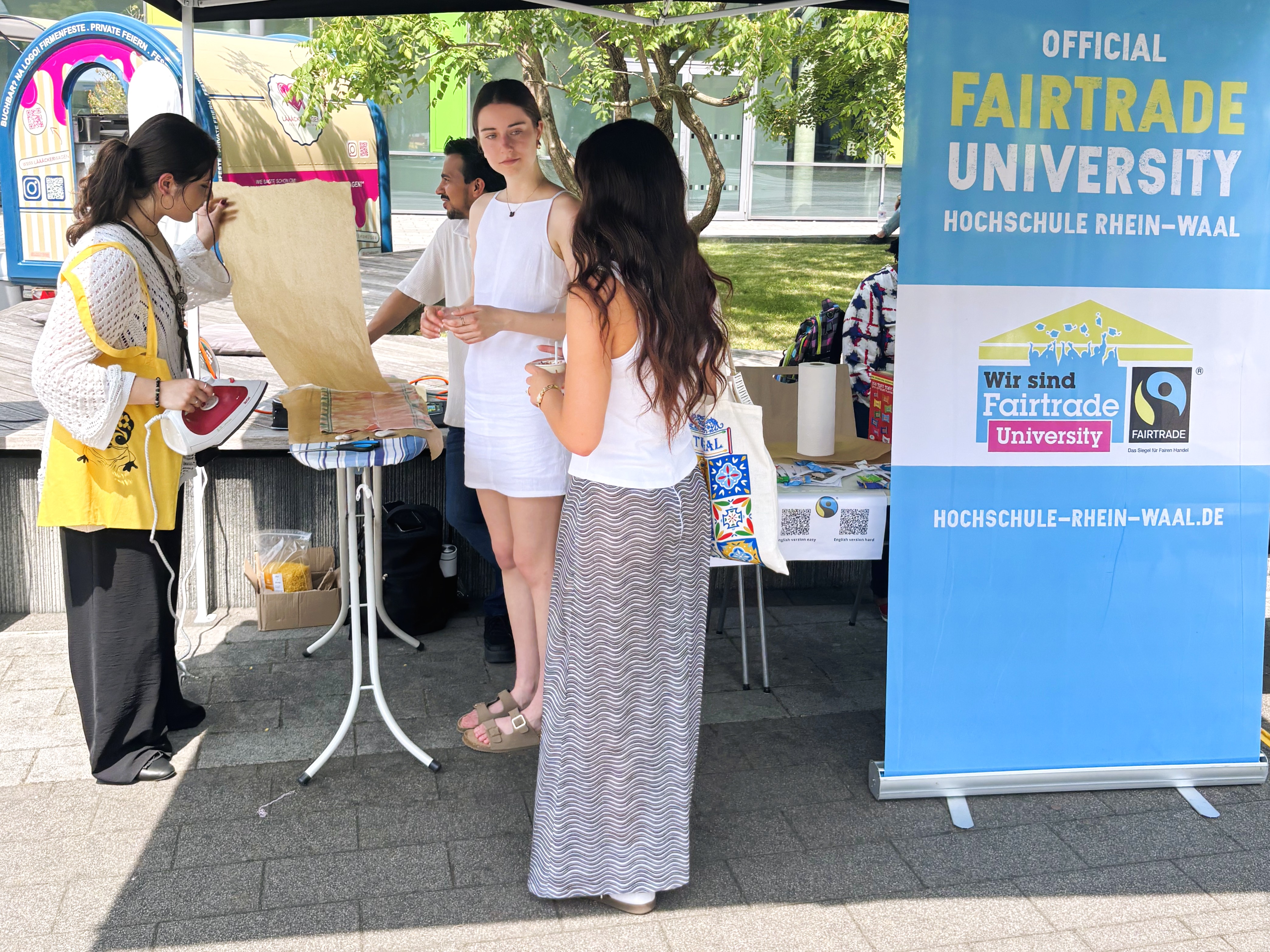
Soon after the launch of this movement, schools, universities and organizations joined to spread awareness. At the Hochschule Rhein-Waal, we have been promoting Fair Trade and sustainable production and consumption activities for years and since 2017 as Fairtrade university. As Fairtrade university we promote fairtrade by offering requesting shops and canteens on both campus to offer also fair trade products and serving fair trade coffee and tea at official events.
Students in our fairtrade student group organize interactive activities that highlight both social and environmental sustainability. These include Batik workshops where participants create unique fair trade bags, sessions on making reusable beeswax food wraps to reduce plastic waste, and quiz nights that raise awareness about Fair Trade history and global challenges. Along these events also information about working conditions in other countries and what fairtrade means is provided.
References:
Fashion Revolution (n.d.) “About” access on https://www.fashionrevolution.org/about/ 19.04.2026
Financial Express (2022) “Why a Garment Worker Works 14 Hours a Day” access on https://thefinancialexpress.com.bd/views/views/why-a-garment-worker-wor… 19.04.2026
Greenhouse, S. (14.05.2013) The New York Times “As Firms Line Up on Factories, Wal-Mart Plans Solo Effort” access on https://www.nytimes.com/2013/05/15/business/six-retailers-join-banglade… 19.04.2026
Hoskins, T. (23.04.2015) in The Guardian “Reliving the Rana Plaza factory collapse: a history of cities in 50 buildings, day 22” access on https://www.theguardian.com/cities/2015/apr/23/rana-plaza-factory-colla… 19.04.2026
IndustryAllGlobal Union (n.d.) “We made it! – Global Breakthrough as Retail Brands sign up to Bangladesh Factory Safety Deal” access on https://www.industriall-union.org/we-made-it-global-breakthrough-as-ret… Z 19.04.2026
Kabir H, Maple M, Islam MS, Usher K (2022) “A qualitative study of the working conditions in the readymade garment industry and the impact on workers' health and wellbeing” Environ Occup Health Pract. 2022 Apr 30;4(1):2021-0020-OHW. doi: 10.1539/eohp.2021-0020-OHW. PMID: 40060310; PMCID: PMC11841785.
Raina, J., Jennings, P (2013) “Accord on Fire and Building Safety in Bangladesh” access on http://bangladesh.wpengine.com/wp-content/uploads/2018/08/2013-Accord.p… 21.04.2026
Schwier, G. (n.d.) “Rana Plaza Building Collapse” Pennsylvania State University cc-sa 3.0, access on https://www.engr.psu.edu/ae/thesis/failures/MKP/failures/failures.wikis… 19.04.202