Teaching Award
"One Mission" is a catchphrase that represents a programme focus within the HSRW's University Development Plan 2030. The aim of the "One Mission" concept is to dovetail teaching, research and transfer in everyday academic life.
As an important key factor for a university of the future, the ‘One Mission’ guiding principle provides the framework for the teaching award topics of the years 2025-2027.
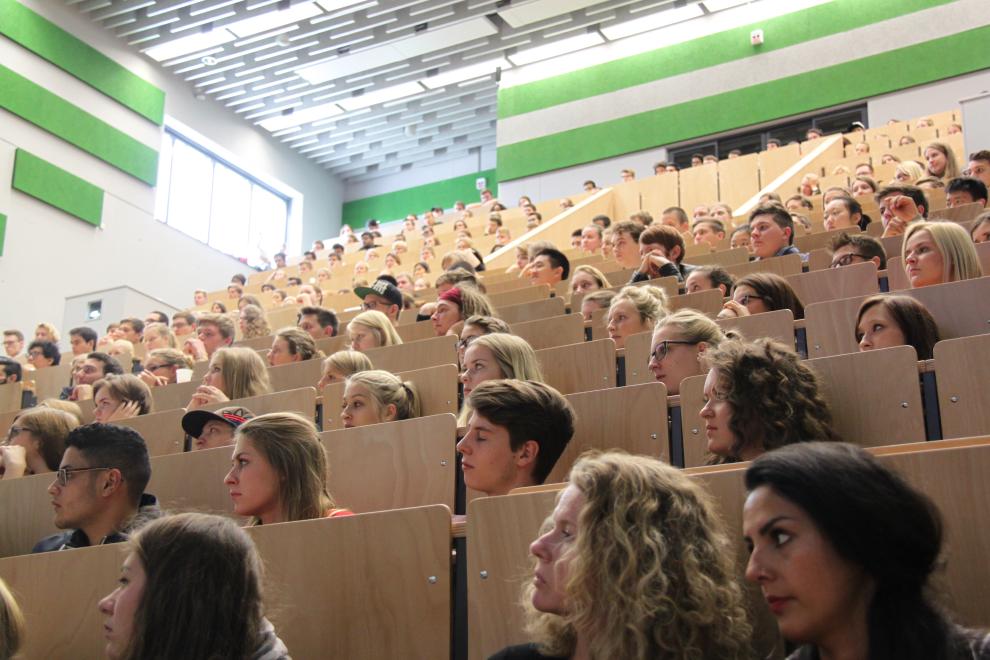
In 2025, the teaching award focused on the aspect of teaching. Here, "Teaching in and for large Groups in Higher Education" was the key motto. In 2026, the focus of the teaching award shifts to the research aspect of the ‘One Mission’ concept and the motto deals with the topic of "research-based learning". Finally, in 2027, the transfer aspect of the ‘One Mission’ idea will take centre stage and the teaching award will focus on the motto "Teaching as a real-world laboratory - with and in practice".
With the awarding of the Teaching Prize, Rhine-Waal University of Applied Sciences underscores the high value placed on the quality of teaching and acknowledges the commitment of its teaching staff.
The Teaching Prize is awarded under an annually changing theme and is endowed with a total of €2.500.
In 2026, the Teaching Prize will be awarded under the theme:
"Research-based Learning"
By encouraging curiosity and critical thinking, learners are not only supported in acquiring knowledge, but also in developing skills that are essential in today's dynamic working world. The inquiry-based learning approach helps to increase student motivation and gain a deeper understanding of complex topics by solving practical problems and developing their own questions.
The following aspects are crucial for the implementation of research-based learning:
- Personal responsibility: Students should have the opportunity to develop their own questions and take responsibility for their learning process.
- Active participation: The learning process should be designed using active methods such as group projects, experiments or discussions in order to motivate students and promote their engagement.
- Interdisciplinarity: Research-based learning should link different disciplines to enable a comprehensive understanding of complex topics.
- Reflection: Students should have regular opportunities to reflect on their learning processes and results in order to deepen their understanding and question their ways of thinking.
- Feedback and evaluation: A constructive feedback culture is essential. Teachers should provide students with timely and specific feedback on their progress and performance.
- Goal orientation: Learning objectives should be clearly defined and comprehensible to students in order to provide them with guidance in the learning process.
- Technological support: The use of digital media and technologies should be integrated in a meaningful way to enrich the learning process and facilitate access to information.
- Cooperation and teamwork: Research-based learning should promote cooperation between students in order to develop social skills and teamwork abilities.
Criteria for awarding the teaching prize
The teaching prize is awarded based on several key criteria that evaluate the quality and effectiveness of teaching and are closely linked to the research-based learning approach:
- Methodological diversity: The course should integrate a variety of teaching methods to promote different learning styles. This enables students to actively participate in their learning process.
- Individualised learning opportunities: The courses should respond to the different needs of the students. Research-based learning often requires students to develop their own questions.
- Constructive feedback culture: A constructive feedback culture is crucial for the learning process. Regular and specific feedback supports reflection and improvement of learning approaches.
- Digital media integration: The use of digital media should promote learning and facilitate access to resources. Technologies can greatly enrich research-based learning.
-
Active student participation: Active participation and engagement are important indicators of teaching quality. Research-based learning encourages students to take responsibility for their learning process.
Who can be nominated?
Nominations can be made by any member of the professorial staff, as well as all academic staff and teaching staff for special responsibilities, who taught at Rhine-Waal University in the summer semester 2025 and/or the winter semester 2025/2026.
Who can nominate?
- Deans (one nomination each)
- FSRs (one nomination per FSR)
- Groups of at least five students (every student can nominate one lecturer)
- Self-nomination (one nomination per person)
Steps
The nominations can be submitted via the nomination tool in the following link:
https://moodle.hochschule-rhein-waal.de/mod/feedback/view.php?id=542988
All nominations received by March 17, 2026, will be considered. Subsequently, the nominated lectuers will be contacted and informed about all details of the procedure. They will be asked to submit the following documents:
- Teaching concept for the nominated course (max. 3 pages DIN-A4)
- Response to questions of higher education didactics regarding their own teaching/learning understanding and the nominated course (max. 3 pages DIN-A4)
- Consent form to make the evaluation results of the nominated course accessible to the Teaching Prize jury
Jury
The jury will consider all nominations submitted before the deadline using a standardised selection process and announce the winner after deliberations have concluded. The jury consists of:
- Professor Dr. Matthias Krauledat, recipient Teaching Award 2025, Faculty of Technology and Bionics
- Dr. Martina Emke, Program coordinator of the network “Hochschuldidaktische Weiterbildung NRW” (hdw nrw), Bielefeld University of Applied Sciences
- Jonas Lamik, Spokesperson for the HEP 2030 group ‘One Mission’
- Kristina Kähler, General Didactics in Higher Education, Ruhr-West University of Applied Sciences
- Michaela Schnappinger, Faculty of Technology and Bionics, Student
- Julia Biggemann, Faculty of Society and Economics, Student
- Bianca White, Faculty of Life Sciences, Student