Workplace Safety: A Burden or a Real Asset for Businesses?
For Sebastian van den Borg, the answer is clear. As a safety engineer and HSRW alumnus (who studied “Quality, Environment, Safety, and Hygiene”), he serves as a daily link between management and the workforce. In this interview, he explains how he ensures safer workplaces, why his studies at the Faculty of Life Sciences provided the perfect foundation for this, and how he successfully balances a full-time position with self-employment.
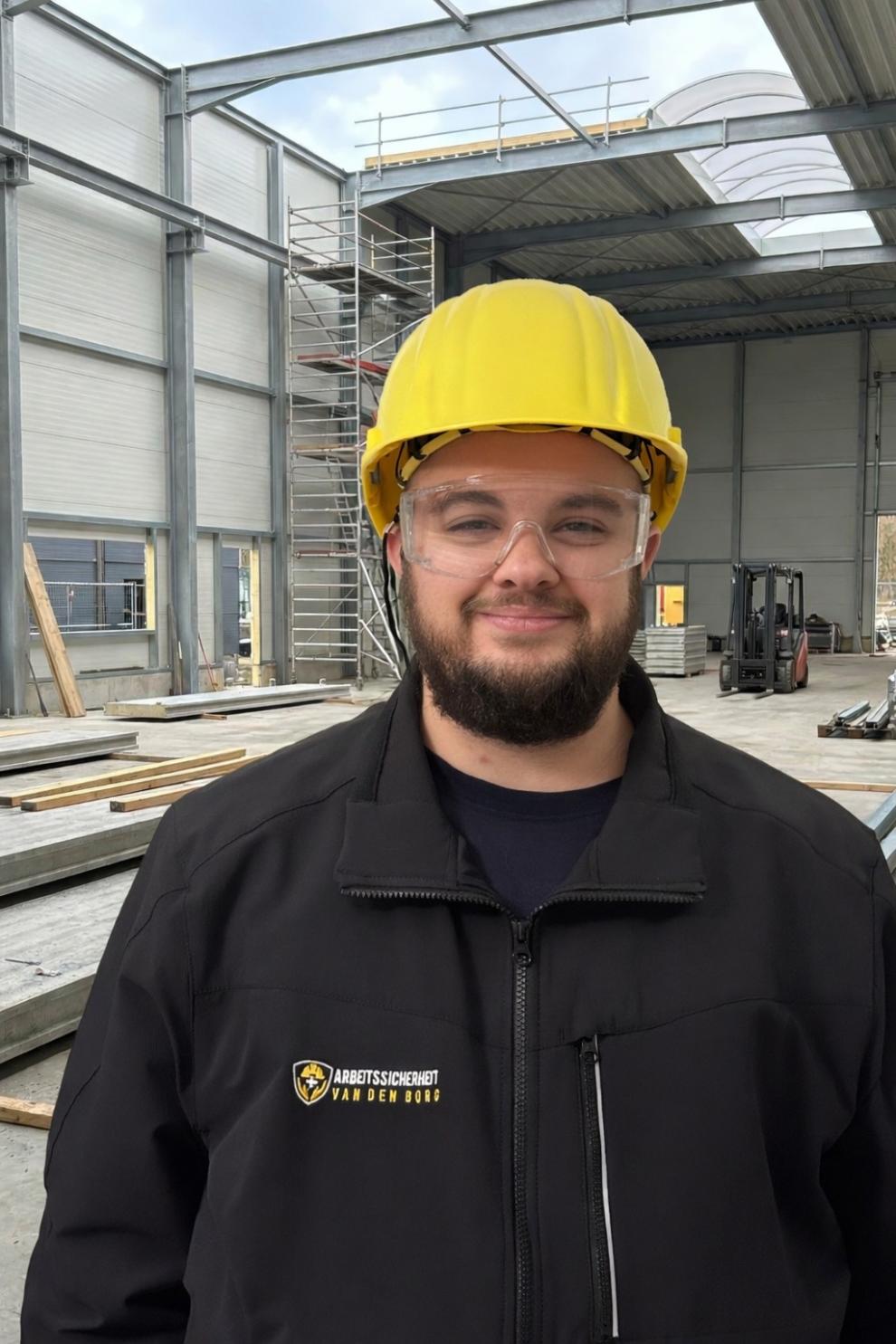
Sebastian van den Borg is a graduate of the Bachelor's degree program in Quality, Environment, Safety, and Hygiene at the Rhine-Waal University of Applied Sciences in Kleve. Today, he works successfully at the demanding intersection of technology and management, primarily as an EHS Manager for around 270 employees in a medium-sized enterprise in the Lower Rhine region, and part-time with his own consulting firm "Arbeitssicherheit van den Borg" (Occupational Safety van den Borg).
In his everyday professional life, it is about much more than just strict compliance with regulations. It is about the active protection of people, legal certainty for executives, and showing managers that occupational safety is not a "brake on production," but actually saves money.
In the following interview, Sebastian van den Borg looks back on his time as a student. He explains why broad fundamental knowledge in the natural sciences is essential, shares exciting insights into his multifaceted daily professional life, and gives future students an essential piece of advice for their own career paths.
Why did you decide to study "Quality, Environment, Safety, and Hygiene" at Rhine-Waal University of Applied Sciences back then?
During the time of my Abitur (high school graduation), I was still quite clueless about how I wanted to develop professionally. Therefore, I used several trade fairs and trial study days, including an open house day at the Rhine-Waal University of Applied Sciences. The topics presented in the field of "Quality, Environment, Safety, and Hygiene" immediately caught my interest – even though I didn't know at the time that I would be drawn towards occupational safety, it was clear to me: this has a future! Topics like occupational safety & quality are important in every company. Added to this was the location of the university; as a native of Kleve, I was happy to stay in my hometown. Life in a big city in a shared student flat would not have been for me.
What should prospective students know if they choose this Bachelor's program?
Prospective students should know that the "Quality, Environment, Safety, and Hygiene" program provides a very broad foundation of knowledge in these areas. The areas are all interconnected, and even if you specialize in one of them later on, you benefit greatly from knowing and understanding the others as well. An example: I focus professionally on occupational safety, but I have major overlaps with the environment and quality management sectors every day. You should definitely bring a certain affinity for natural science subjects like chemistry and mathematics.
You navigate the intersection between technology and management. What skills did you acquire during your studies that you can apply particularly well in your job today? For example, how do you explain to a commercial managing director, who primarily looks at the budget, that an expensive investment in safety ultimately saves cash?
The basics in the first two semesters were "surprisingly" strongly focused on STEM subjects for me back then, and therefore sometimes really challenging. However, I use this broadly acquired foundational scientific knowledge every day in my professional life now. Complementary skills from my studies, such as communication and conflict management, also help immensely. In the end, though, it is often simple mathematics that changes management's mind. While investments often hurt at first, the costs of a serious workplace accident and the associated downtime usually exceed them many times over.
Occupational safety specialists are often mistakenly seen as "naysayers" or a "brake on production." What argument do you use to convince new clients that you are not a cost factor, but a hallmark of quality that can be used for advertising?
Good question. I wouldn't even necessarily call it a hallmark of quality, but rather something necessary to create legal certainty. Of course, this shouldn't scare entrepreneurs of smaller companies in particular, but every managing director must be clear that the factor of personal liability is always present in the area of occupational safety, right from the very first employee. If you take care of the issue and actively protect your employees or provide safe workplaces, you don't have to worry about it. Not to mention that workplace accidents are always associated with downtime, which small and medium-sized companies in particular often cannot afford. Managing directors usually have so many issues on their plates that the topic of occupational safety (which can certainly be complex) often finds no room. If you can work with a service provider at eye level here, the topic of occupational safety is at least one less thing to lose sleep over at night. And let's be honest - as an employee, would you rather work in a company that aligns everything towards you going home healthy in the evening, or in a company where that's more a matter of luck?
What do you like most about your job?
What I like particularly well about my job is creating real added value for EVERYONE. You give the employer / entrepreneur legal certainty through your own expertise. For the employees, you can create a significantly more attractive working environment. Even if occupational safety often seems "dry" and "bureaucratic" and many people initially have reservations or even show rejection. At the end of the day, only one thing counts – we all want to come home healthy in the evening!
Many students dream of self-employment but shy away from the risk. What is personally the biggest advantage for you in being your own boss?
To be fair, my self-employment is purely a sideline business. I work full-time as an EHS Manager and internal occupational safety specialist in a medium-sized company with currently around 270 colleagues here in the Lower Rhine region. On the one hand, I enjoy the perks of "being an employee," keyword: health insurance and fixed structures. Clear tasks with responsibility for implementation and not just pure "consulting" are fun for me. However, self-employment as a sideline business offers me the great advantage of getting to know many other companies and processes beyond that. In doing so, I can offer entrepreneurs real added value through professional advice, which most of them wouldn't have the mental space for themselves. Being able to experience both sides daily is an exciting balancing act where I can always continue to learn.
What I would like to pass on to future students: No matter which role you prefer, whether employer or employee – "Quality, Environment, Safety, and Hygiene" offers you the best prerequisites for climbing the career ladder, whether in the private sector, in public service, or in self-employment. A factor that I didn't consider when I started my studies, but highly appreciate today.
If you could give the student Sebastian van den Borg at the Faculty of Life Sciences a single piece of advice for starting his professional life today, what would it be?
Do what you enjoy professionally.
There is so much new and in-depth knowledge to learn, day by day. Over the course of a professional life, you build up an enormous amount of expertise, which is certainly lacking in one place or another at the beginning and can sometimes seem overwhelming. But over the years, you become more secure and self-confident, and your environment perceives this as well. Working life is a large part of our lives, so you should really pursue what you enjoy and what you can find fulfillment in. Finding that can take time and is certainly not always the "easiest" path you can choose – but it is worth it.