
Ask Sebastian: Can a Slime Mold Predict the World Cup?
There is a single-celled organism sitting in a laboratory right now, slowly spreading across a petri dish. It has no brain, no neurons, and no idea what football is. Yet we are about to ask it a question usually reserved for analysts, algorithms, and people arguing in cafés: Can this strange little organism pick the winner of the World Cup?
Its name is Physarum polycephalum, better known as the “many-headed slime.” It is one cell with thousands of nuclei, a biological oddity that behaves less like a single organism and more like a living network. It does not think, predict, or understand the game. It simply grows, explores, and adapts according to the information available in its environment.
And that is exactly why it is interesting.
Rather than asking whether the slime mold can see the future, we wanted to see what happens when a biological system is given a football ranking model and allowed to make decisions with its own unpredictable logic.
How does a slime mold choose a winner?
Physarum is a plasmodium — essentially one enormous cell that can spread across a surface searching for nutrients. Its growth is not purely random. The slime responds to chemical signals from food sources and environmental conditions, extending its network toward favorable areas while constantly exploring alternatives.
This balance between exploration and efficiency is what makes the organism fascinating. It can look chaotic at first, but over time it creates surprisingly efficient pathways. In previous experiments, researchers have even shown that slime mold growth can recreate efficient transport networks similar to real-world systems, including the Tokyo rail network (Tero et al., Science, 2010).
The slime is not solving a problem consciously. It is following simple biological rules that, when repeated, can produce complex outcomes.
So we asked: what happens if we turn those rules into a football prediction system?
Turning Elo ratings into slime mold decisions
For each fixture in the World Cup bracket, we created a biological version of an Elo rating system.
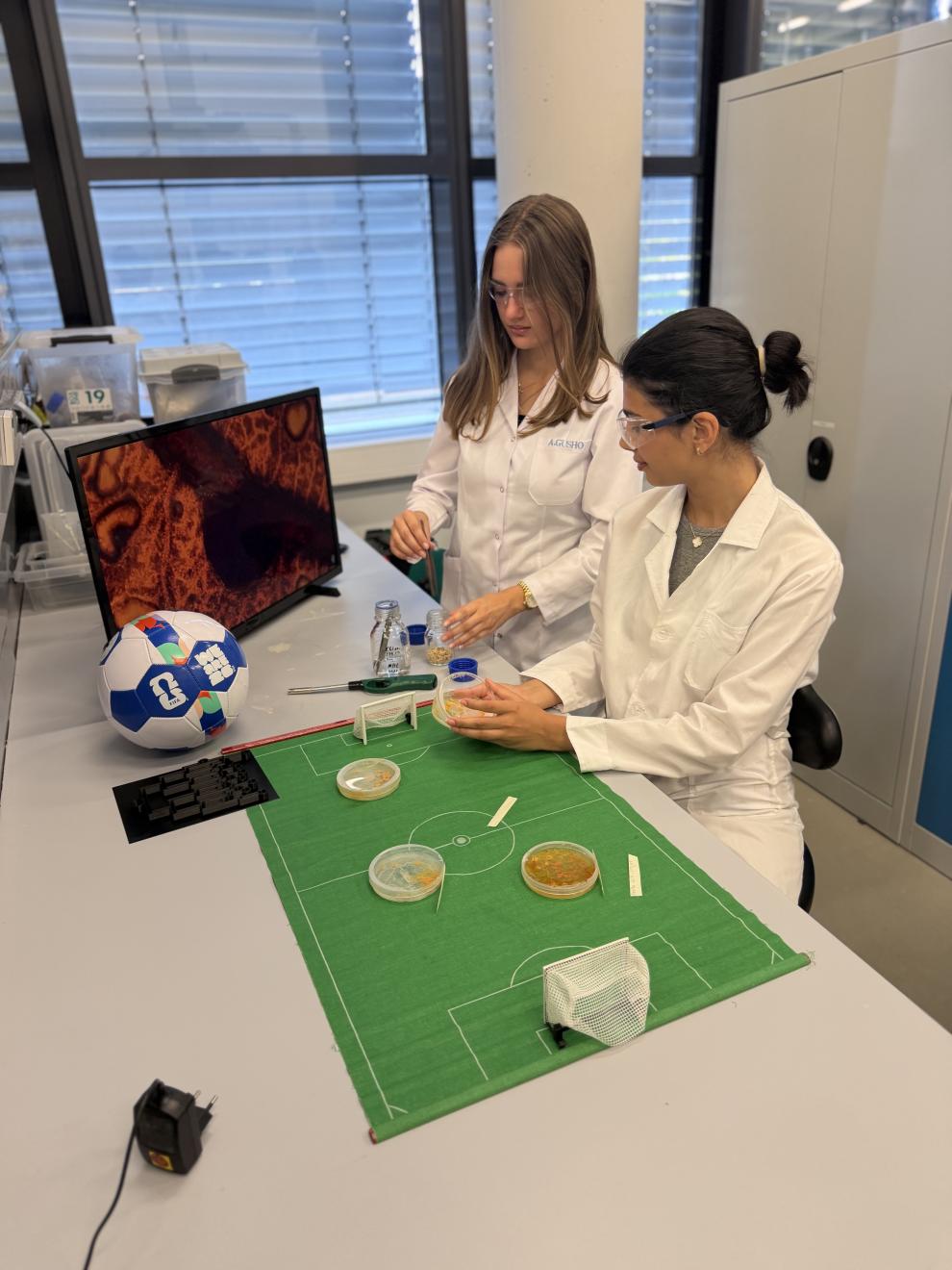
The idea was simple: each team was represented by an oat flake, and the distance of that oat flake from the slime’s starting point was determined by the difference in Elo rating between the two teams.
The stronger team — the one with the higher Elo rating — was placed closer to the slime, while the weaker team was placed further away.
The distance conversion was calculated using:
Linearization of E and F = E = (Eteam - Eᴍɪɴ) / (Eᴍᴀx - Eᴍɪɴ) , F = (Fteam - Fᴍɪɴ) / (Fᴍᴀx - Fᴍɪɴ)
Then the ratings are put inside S = 0.8E + 0.2F
The resulted score will be turned into distance with d = 4 - 2S
F is the number of wins and losses and draws based on the 5 last games.
This conversion was the heart of the experiment. The slime mold itself was not creating a prediction model; it was physically carrying out a model that we designed. The organism became a biological computer running Elo rankings through a living, unpredictable system.
If the slime reached the closer oat flake first, it was counted as choosing the higher-ranked team. But because Physarum does not grow in a perfectly controlled way, its decisions were never guaranteed. The same noise and exploration that make slime mold behavior interesting also make it unpredictable.
The goal was not to prove that slime mold knows football.
It was to see what happens when mathematics meets biology.
The people behind the experiment
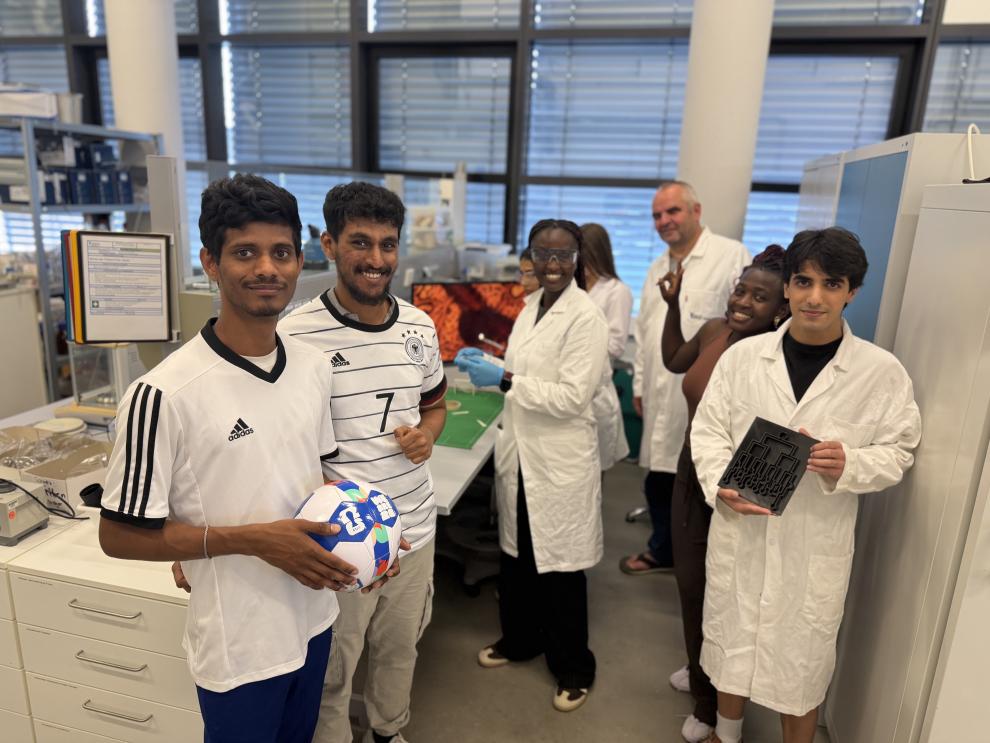
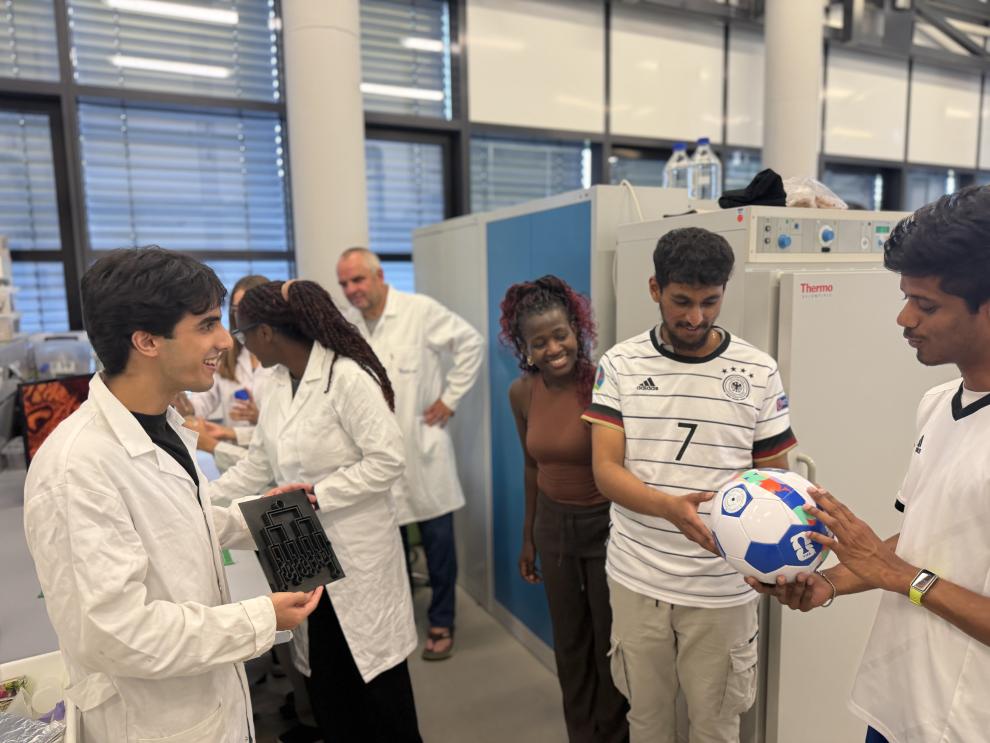
The project was carried out by seven team members divided into three groups: the bio coaches, the data tacticians, and the tech scouts.
The bio coaches — Tariq, Amelia, and Maryam — were responsible for preparing and maintaining the slime mold cultures throughout the experiment.
The three of us came from different backgrounds. I am studying Sustainable Agriculture and come from Kuwait, where my connection to biology started through understanding how living systems interact with their environments. Amelia, studying Bioengineering, brought a more engineering-focused perspective from Albania, while Maryam, also studying Bioengineering, approached the experiment through the lens of biological systems and design.
Rather than simply watching a football prediction happen, we were watching a conversation between mathematics, biology, and human curiosity.
The remaining team members handled the Elo calculations, spatial setup, data collection, and technical infrastructure needed for the time-lapse recordings.
Watching it grow
Each match was filmed for around 12 hours using time-lapse recording.
Watching the footage is strange. The slime slowly expands outward, sending out branching tendrils in different directions. It looks almost like a search algorithm made visible.
But the important part is not simply which oat flake it reaches first. The interesting part is the uncertainty.
Sometimes the slime reaches the expected choice based on Elo. Sometimes its chaotic exploration leads it somewhere else. The organism is not faithfully copying the ranking system; it is adding its own biological variation.
That unpredictability is not a failure of the experiment. It is the reason for doing it.
A computer model will always give the same answer. A living system might surprise you.
Not a prophet — a biological computer
Of course, the slime mold cannot predict football in the way a human analyst or statistical model attempts to. It does not know about injuries, tactics, substitutions, red cards, or the millions of factors that influence a tournament.
But that was never really the point.
The slime mold was not a prophet. It was a biological computer with a mind of its own on some nights.
We gave it an input — the Elo ranking system — and watched a living organism process that information through its own rules. The result was a mixture of mathematics and biological noise: sometimes logical, sometimes surprising, always fascinating.
So, did Sebastian the slime mold predict the World Cup winner?
Argentina?
Maybe the answer is yes. Maybe it is no.
But the more interesting discovery is that prediction was never the whole story. The real experiment was watching what happens when a mathematical model leaves the screen and enters the unpredictable world of a living organism.