 Go to Rhine-Waal University

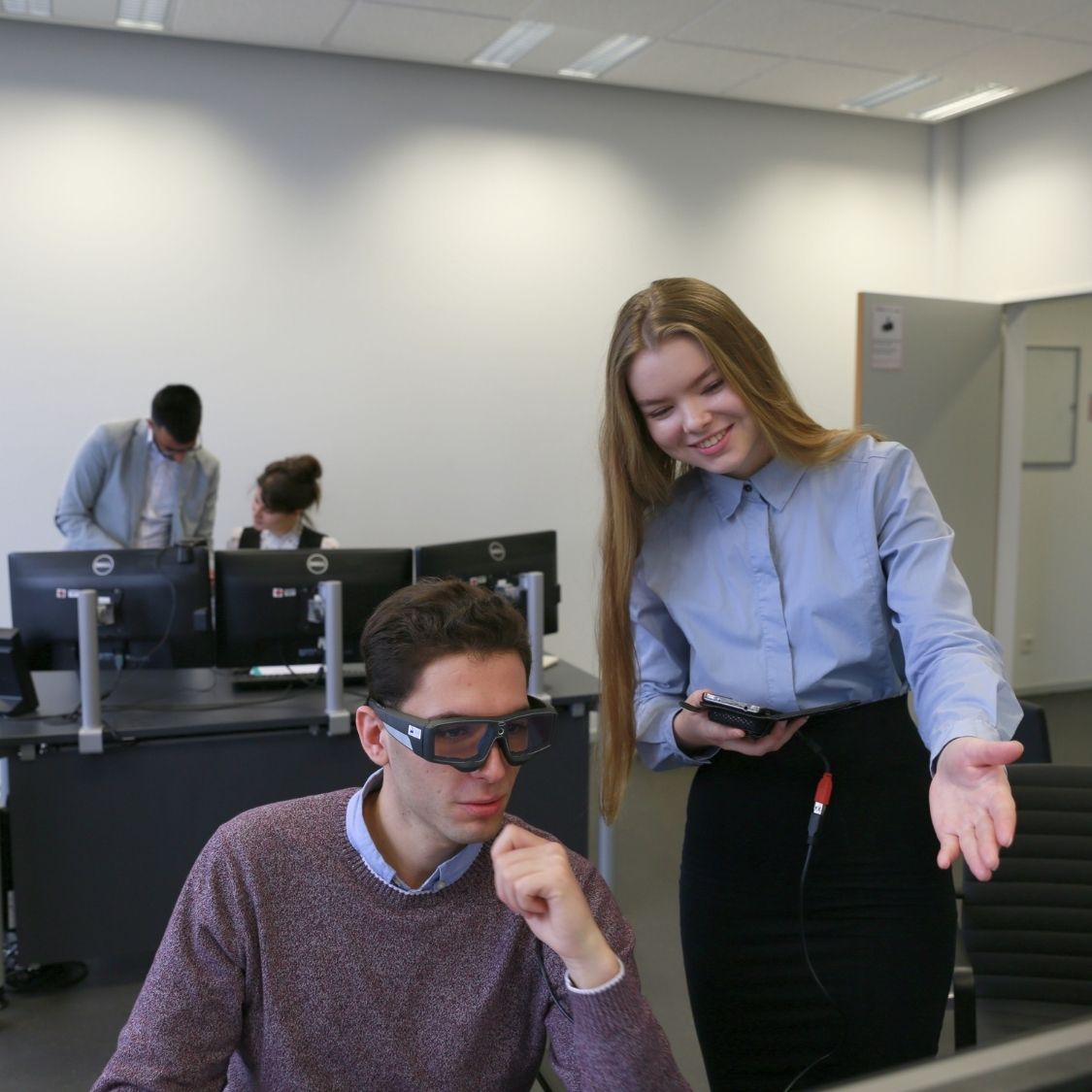
The newly established Faculty of Society and Economics is characterised by a particularly strong focus on practical application and places great emphasis on the interconnection between research, entrepreneurship and the regulatory framework. The faculty focuses on current societal challenges, such as energy and resource scarcity, the ongoing transformation towards a digital knowledge society, the effects of demographic change and the question of competitiveness in an increasingly globalised world. Furthermore, the Faculty boasts a high degree of internationality: English-taught degree programmes are particularly attractive to international students, who in turn promote intercultural exchange through their own ideas and experiences. Collaborations with leading international universities and companies open up exceptional personal development opportunities for students.
To ensure a close integration of theory and practice, a laboratory environment for experimental research has been established.

Laboratory overview
strateGiX Laboratory for Experimental Economic Research
The group simulation rooms are used to conduct experiments analysing the influence of group dynamics on decision-making processes and behaviour. The Laboratory for Experimental Economic Research is equipped with 24 individual booths with privacy screens.
Areas of application include
- Investigation of decision-making behaviour in situations of interdependence,
- the influence of group dynamics on decision-making behaviour,
- Testing models of decision-making and game theory,
- Design of auctions and auction mechanisms,
- Analysis of preference structures in relation to various factors,
- Research into the relationship between economic and social behaviour,
- Investigation and optimisation of negotiation strategies,
- Simulation of real-world negotiation and decision-making situations,
- Examination of the effect of monetary incentives on decision-making
KLEX – Experiencing and experimenting with early childhood learning.
The KLEX learning workshop is a dynamic space for learning and hands-on experience, designed for students of early childhood education and for children. Here, learning processes are shaped in an active, exploratory and creative way: students test educational concepts in a practical setting, support children as they discover and reflect on their experiences within an academic context. Open-ended materials, prepared learning environments and regular visits from partner nurseries make KLEX a central hub for learning, teaching and research.
Further information is available at www.lernwerkstatt-klex.de
TaXES Laboratory for Tax Experiments and Simulations
In the Laboratory for Tax Experiments and Simulations, conversations and negotiation scenarios are re-enacted, observed via audio-visual means and analysed. Possible scenarios might include, for example: discussions between tax advisers and clients, between tax authorities and citizens, constructive crisis talks, and meetings of conference tax departments.
MatRiX Laboratory for Market and Stock Exchange Simulation
This laboratory focuses on simulating trading activity on financial markets and analysing the behaviour of participants in decision-making situations. The simulation is based on real financial market data. Participants are provided with information from relevant databases and must adjust their behaviour accordingly. Their decision-making behaviour and its consequences are then analysed. The analysis is not intended to cover only the participants’ quantitative decisions. In addition to the participants’ pure reaction in a decision-making scenario, the focus is on investigating how the decision is formed. This two-stage approach to experimental research creates an interconnection between economics and behavioural research that reflects the diverse facets of the entire faculty. The data collected will be used to quantitatively map how participants react in stressful and decision-making situations. In particular, the aim is to investigate the influence of controlled information on participants’ decision-making.
BOX Laboratory for Behaviour, Observation and Experience (Behaviour, Observation & EXperience)
A common feature of the Faculty’s degree programmes, which cover a very wide range of subjects, is that all graduates, in their diverse professional fields, should possess strong interpersonal and communication skills when dealing with people of different ages, genders, backgrounds, cultures, etc., as well as a professionally reflective attitude, enabling them to
act in a manner appropriate to the situation, in a respectful and inclusive way,
overcome communicative and cultural barriers,
collaborate across disciplines and teams,
constructively facilitate and support situations of change and conflict,
develop attitudes towards their own professional role and responsibilities through a shared process of reflection
This is precisely where the laboratory’s focus lies: it provides a space to develop and deepen, in an application- and practice-oriented manner, the areas of counselling, communication/conflict resolution, and the development of a professional, ethical approach when working with the relevant professional target group.
The room is equipped with modular furniture and relevant counselling materials, enabling it to be used flexibly in various settings (groups of up to around 15 people). In addition, an integrated camera system can be used to observe, record and analyse relevant interaction sequences, and can be utilised for documentation, reflection and supervision.
Contact
Room: 02 EG 010
BOX-FGO@Rhine-Waal University of Applied Sciences.de
Head of Laboratory: Prof. Dr Corinna Titze
We conduct a wide variety of experiments in our laboratory facilities on a diverse range of topics. Using the results, we seek to analyse how people make decisions and how these decisions can be described and modelled using theoretical frameworks. Depending on the field of study, various experiments are carried out, such as the investigation and optimisation of negotiation scenarios or the conduct of scenario bundle analyses. The experiments are developed by professors, Research Associates and students as part of research projects, seminars or for final dissertations.
Anyone can take part in the experiments! If we have sparked your interest, please register in our participant database. When a new experiment is due to take place, we will invite you by email.
Where do the participants come from?
We need participants for the experiments. Not only students can take part, but external participants are also warmly invited to join the experiments. Anyone interested can register in our database and will then receive invitations to various experiments.
What do participants do?
Participants are briefed on all the details at the start of each experiment. No prior knowledge or specialist expertise is required to take part in the experiments. Our promise: all experiments are conducted exactly as described in the instructions. We will never manipulate you or lie to you!
And I can earn money doing it!
Payments depend on the type and duration of the experiments. Sometimes the amount is lower, sometimes higher. The hourly rate is approximately €8.
If you have any further questions, please take a look at our Frequently Asked Questions (FAQ).
Laboratory information
Wednesdays 11am–1pm
Building 03, 1st floor, Room 03 01 015 (Director’s Office) or by appointment.
For an individual appointment, please contact us:
xpertise(at)