Hygiene Detectives get primary school children excited about science and hygiene
Explaining science clearly and implementing their own projects – that was recently the focus of the "Hygiene" elective at the Faculty of Life Sciences at Rhine-Waal University of Applied Sciences. Under the direction of Prof. Dr. Dirk Bockmühl, students from the fields of Biosciences, Health, as well as Quality, Environment, Safety, and Hygiene developed an interactive hygiene afternoon. The program was aimed at the St. Hubertus primary school in Kevelaer and took place as part of the MINTmachtage 2026 (STEM Discovery Days).
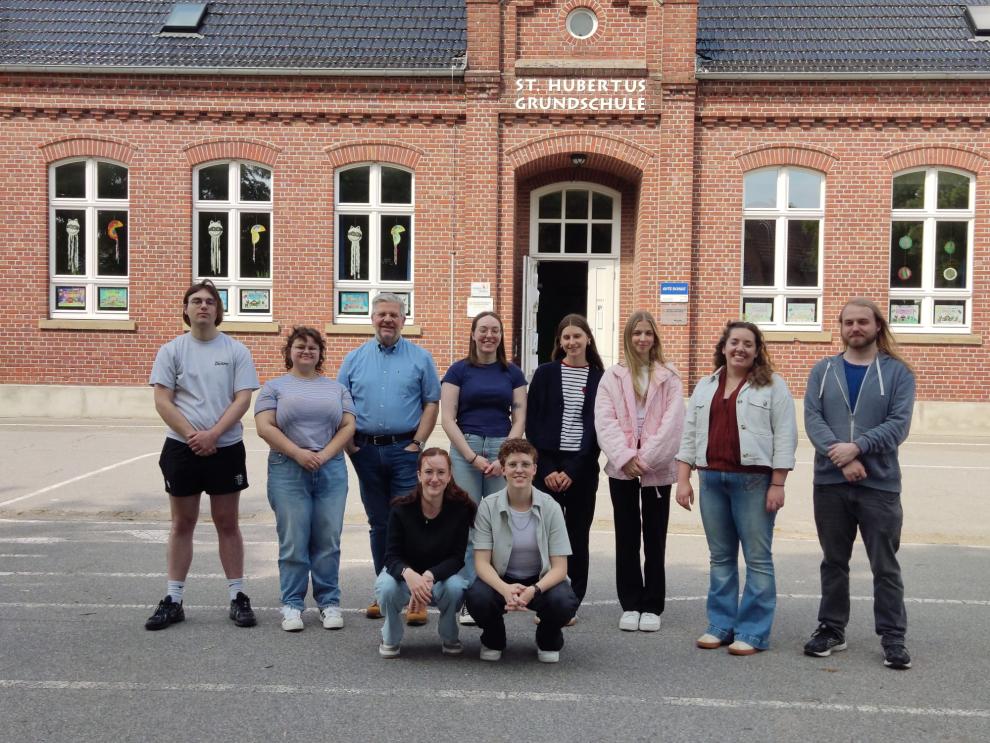

From left to right: Jan Verhoeven, Emma Wanders, Prof. Dr. Bockmühl, Nina Maywald, Joana Rexwinkel, Katharina Hoffmann, Antonia Lievre, Kamila Bartnikiewicz, Konstantina Tsanis, Maik Sattelmeier.
Working as the "Hygiene Detectives" group, the students prepared scientific content in a child-friendly way. The goal was to introduce the primary schoolers to the natural sciences through play. At the same time, it was a chance for the students to put their theoretical knowledge to the test in practice.
From the laboratory experiments to the public relations work, the organization was entirely up to the students. Alongside the technical hygiene topics, they learned a lot about science communication, project management, and teamwork. During regular meetings, they discussed their progress and new ideas. This collaboration also resulted in a joint social media takeover on the university's Instagram channel.
The action day at the St. Hubertus primary school kicked off with a certificate presentation by the "Kinder forschen" (Little Scientists) initiative, which Kevelaer's mayor, Dr. Dominik Pichler, also attended. Afterward, the children from the after-school care program visited various hands-on stations. Armed with stamp cards, they set off to explore the world of microorganisms.
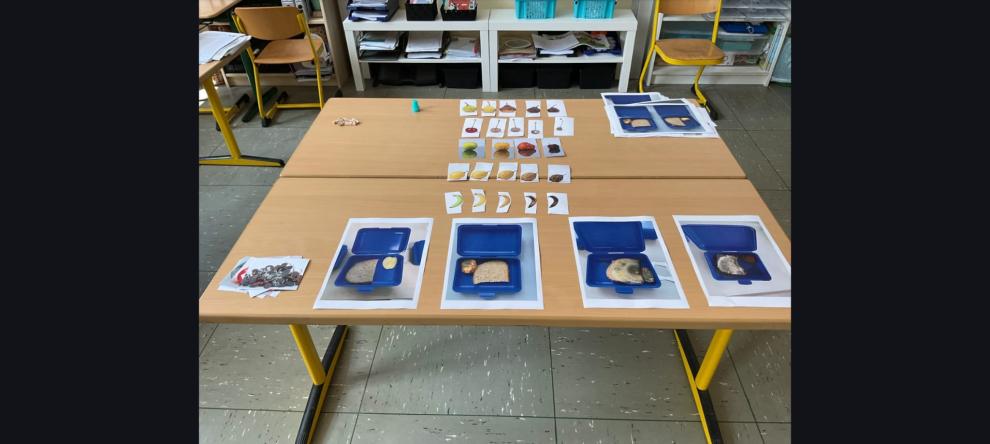
At the stations, the children found out why we need to wash our hands, how bacteria cause foul odors on damp towels, and why food gets moldy. Through smelling samples and small experiments, the scientific concepts suddenly became tangible.
"We designed the project ourselves from the initial idea right through to the final execution," reported one of the participating students. "In the process, aside from the actual subject knowledge, you learn above all how important teamwork and project organization are. Seeing how focused the children were as they participated at the stations made all the hard work worthwhile."
The project showed just how hands-on the Life Sciences can be. With it, the Hygiene Detectives successfully put into practice exactly what the MINTmachtage are all about: making science a concrete, hands-on experience for young people.