
Developed in Krefeld, analysed in Kamp-Lintfort.
HSRW – Thomas Klimeck
Developed in Krefeld, analysed in Kamp-Lintfort.
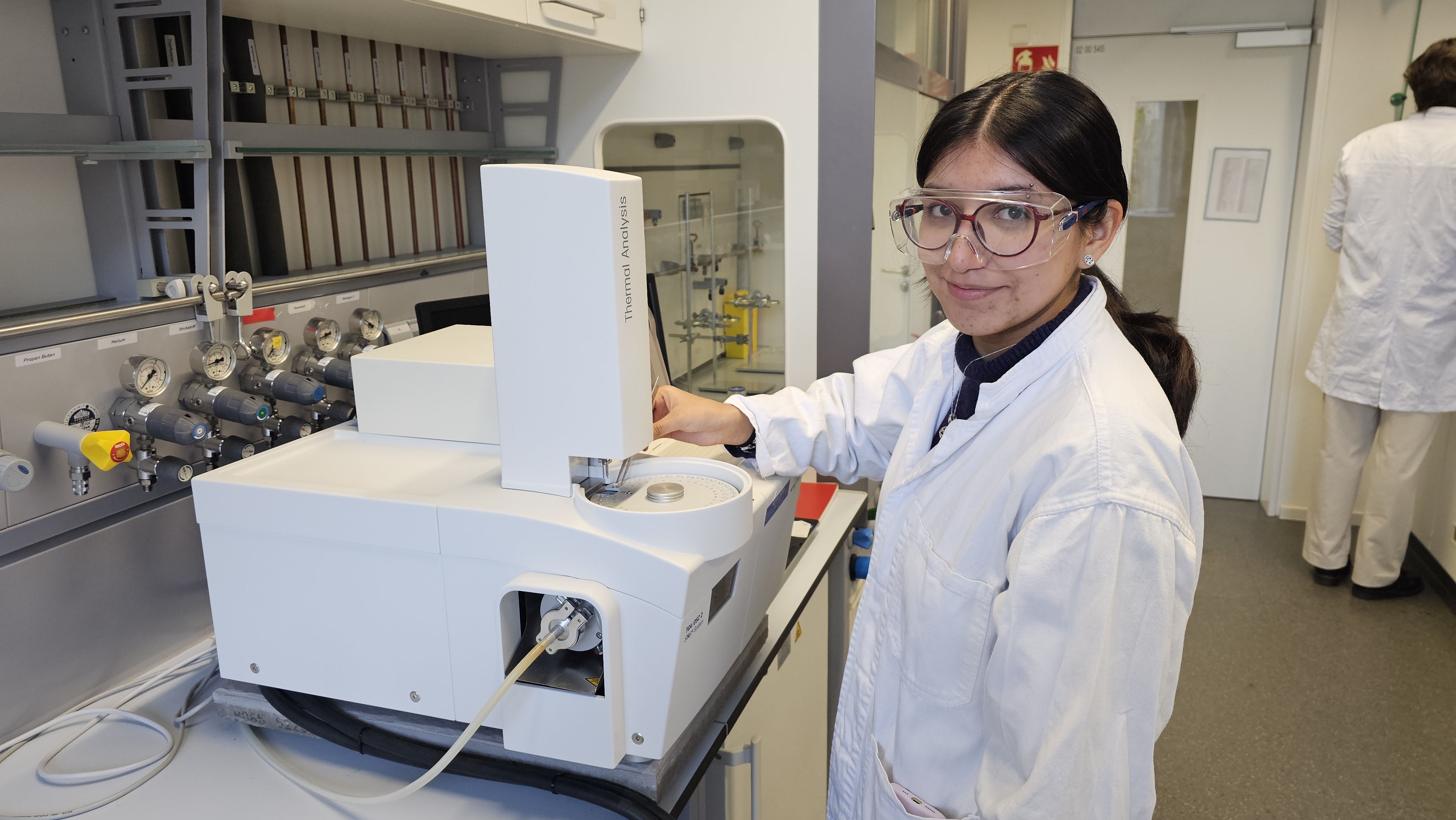
Martina Sanguino is studying Materials Science Engineering at the Institut Universitaire de Technologie (IUT) in Chalon-sur-Saône, France. She is currently undertaking her three-and-a-half-month compulsory work placement in the hydrogen laboratory at the Faculty of Communication and Environment at Rhein-Waal University of Applied Sciences. Among other things, she is involved in the scientific investigation of novel materials for hydrogen and energy technology.
Whether it be hydrogen technology, energy storage or other electrochemical applications, the performance and service life of technical systems depend largely on the materials used. So-called nanofibre non-wovens are of particular interest in this context. They consist of a network of extremely fine fibres which, due to their small diameter, have a particularly large surface area in relation to their volume. By specifically designing their structure and composition, their properties can be adapted to different technical requirements. For example, functional layers or catalysts can be incorporated.
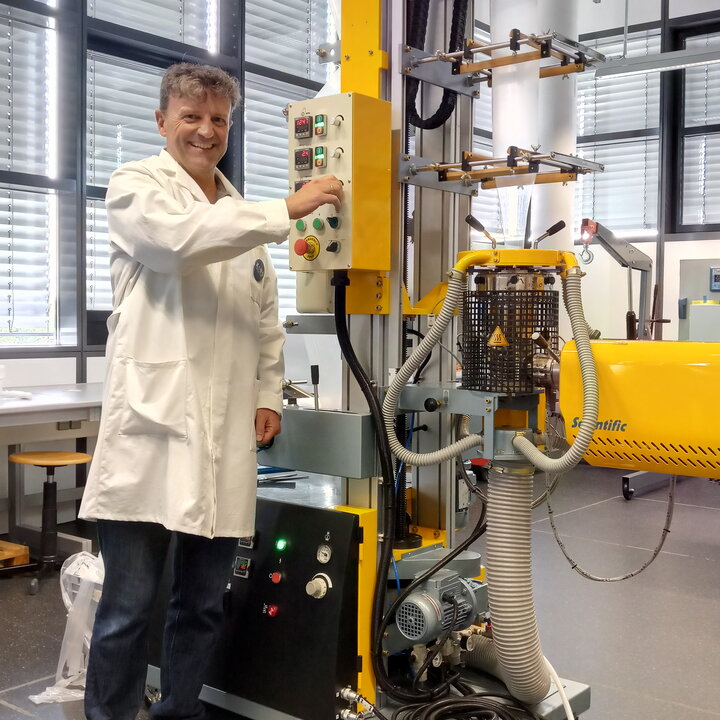
Many companies and research institutions are working on the development and optimisation of such materials to drive forward innovative and high-performance technologies. This includes the Green Chemistry & Nanotechnology research division at the German Textile Research Centre North-West (DTNW) in Krefeld, headed by Dr Thomas Mayer-Gall. The research work of Eui-Young Shin plays a central role in this. Using a process known as electrospinning, ultra-fine polymer fibres are produced, which can then be further processed, for example, through subsequent thermal treatment processes.
Recently, materials resulting from this DTNW research have also been investigated at the hydrogen laboratory of the Faculty of Communication and Environment at Rhine-Waal University of Applied Sciences. The focus here is particularly on gaining a better understanding of their chemical, thermal and structural properties and assessing their suitability for future applications in hydrogen and energy technology.
Martina Sanguino is supporting the scientific investigation and characterisation of the various materials. In addition to her laboratory work at the university, she will also be visiting the DTNW in Krefeld. There, she will gain an insight into the production of nanofibre nonwovens using electrospinning and learn about the various stages of material development. The combination of material production and subsequent analysis gives her a comprehensive insight into scientific workflows – from the development of new materials to the evaluation of their properties.