
A clearly structured and concise overview of the research activities and development achievements at the Plastics Technology Centre is intended to help facilitate dialogue with companies.
HSRW – Catrin Senger
A clearly structured and concise overview of the research activities and development achievements at the Plastics Technology Centre is intended to help facilitate dialogue with companies.
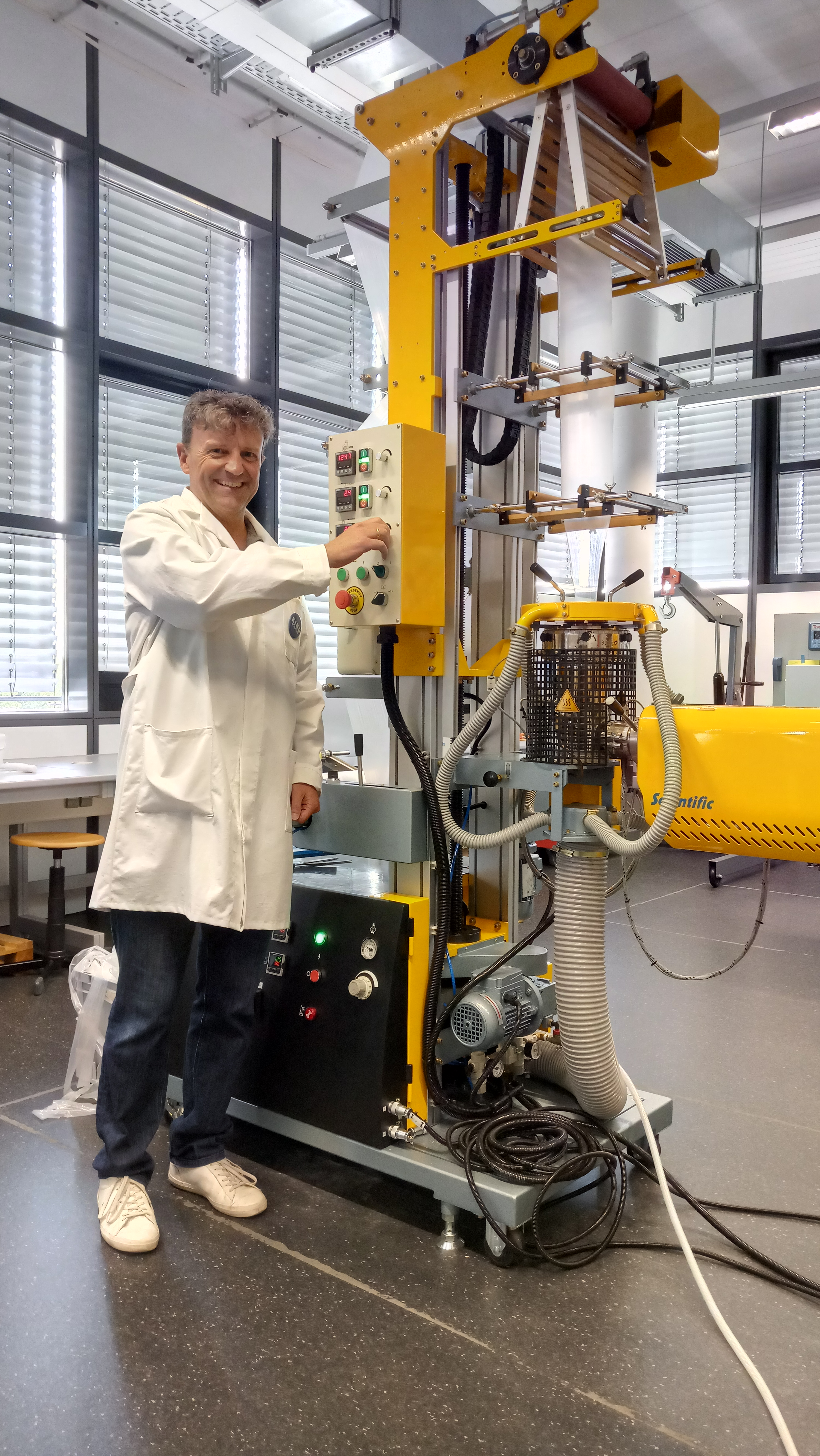
At the Plastics Technology Centre of the Faculty of Technology and Bionics on the Kleve campus, research is being carried out into new formulations for plastics. The laboratory, headed by Prof. Dr Christoph Heß, focuses on so-called bioplastics, i.e. bio-based and/or biodegradable plastics, which are based, for example, on sugar or starch. Students at the faculty have access to a range of machines and equipment. For example, they can use the compounding line to produce new formulations, process the resulting pellets into products using a blown film extruder or injection moulding, and then analyse their properties. These properties include, amongst others, strength, degradability, and resistance to corrosion, temperature and weathering. How does this differ from large plastics-manufacturing companies?
“With our pilot-scale machinery, we can quickly produce a wide variety of blends in small quantities – sufficient for further processing and characterisation, yet without causing excessive consumption of raw materials. This simply isn’t feasible with large-scale production machinery.”
Christoph Heß is thus addressing a niche for collaborative projects with companies: the research and development of innovative plastic compounds without the need for expensive and resource-intensive use of production machinery. According to Prof. Heß, smaller companies in particular often benefit from collaboration with the HSRW, given the testing methods available at the pilot plant. This is because they often do not have the necessary equipment or their own research and development department. What are the benefits for the Plastics Technology Centre and the students? Full utilisation of capacity, practical experience in an innovative environment and valuable contacts with industrial companies operating both regionally and nationally.
How can this offering be communicated to the outside world? Prof. Heß comments:
“It was clear to me that we didn’t need a list of laboratory equipment, but rather had to demonstrate what the laboratory is capable of. We take a down-to-earth approach, even to seemingly simple problems; we can investigate and help. The most important thing – also to reduce any reservations – is to strike up a conversation.”
Together with Julia Roelofsen, the business innovation manager for our project, he has drawn up a clearly structured and concise overview of the research tasks and development work carried out in his laboratory. He explains: “We want to support companies in the development, evaluation and implementation of innovative material solutions.” Julia Roelofsen’s outside perspective proved helpful here. As a link between the university and industry, she understands the needs of companies as well as the barriers to collaboration that need to be overcome.