
Research links Krefeld and Kamp-Lintfort.
HSRW – Thomas Klimeck
Research links Krefeld and Kamp-Lintfort.
Innovative materials play a crucial role in the further development of hydrogen technology. Rhein-Waal University of Applied Sciences and the German Textile Research Centre North-West (DTNW) in Krefeld are working together to investigate such materials and gain a better understanding of their potential applications. Ultra-thin membranes and electrospun nanofibre non-wovens play a key role in this.
Anyone wishing to produce green hydrogen on an industrial scale cannot avoid electrolysis. In this process, water is split into hydrogen and oxygen using an electric current. If the electricity required comes from renewable energy sources, the result is known as green hydrogen. This is regarded as one of the key building blocks of the energy transition, particularly for industrial processes that are difficult to electrify directly.
A key component of many electrolysers is the membrane. It separates the resulting gases from one another whilst simultaneously enabling the targeted transport of electrically charged particles. Membranes are also used in fuel cells, where hydrogen is electrochemically reacted with oxygen to generate electrical energy.
For membranes in electrolysers and fuel cells to function reliably, they must meet various requirements simultaneously. They must conduct protons – that is, positively charged hydrogen ions – as efficiently as possible, whilst acting as electrical insulators and largely preventing the unwanted passage of gases. Furthermore, they must withstand mechanical, chemical and thermal stresses over the long term.
Consequently, such membranes are made either from special ion-conducting polymers or from polymers into which an ion-conducting substance can be incorporated. Inert polymer fibres can also be added for mechanical reinforcement.
Particularly fine fibre materials are also of interest outside the membrane itself. Electrospun nanofibre non-wovens, for example, can serve as support structures for precious-metal catalysts. Owing to their large specific surface area and their adjustable pore structure, they offer interesting possibilities for making electrochemical processes more efficient.
The Green Chemistry & Nanotechnology research division at the German Textile Research Centre North-West (DTNW) in Krefeld, headed by Dr Thomas Mayer-Gall, is engaged in the development of such materials. A key role in this work is played by PhD student Eui-Young Shin, who is conducting research into the production, characterisation and further development of electrospun nanofibre nonwovens.
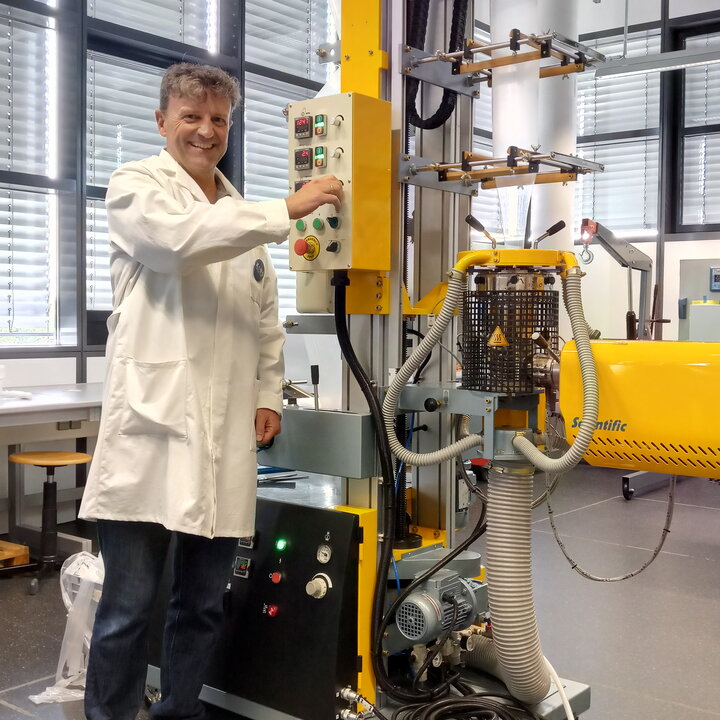
The so-called electrospinning process is used in the production. In this process, a polymer solution is exposed to a strong electric field. The electrical forces pull the liquid apart into extremely thin fibres, which are then collected on a surface. This produces fine fibres, some of which are only a few hundred nanometres thick, which together form a non-woven fabric.
By varying the starting materials and production parameters, it is possible to specifically influence fibre diameter, porosity and other properties. One example is non-woven fabrics made from polyacrylonitrile (PAN). As PAN itself has no significant proton conductivity, it must be chemically modified or combined with ion-conducting materials for such applications. Various PAN polymers are being used as part of the joint research. These include specially synthesised homopolyacrylonitrile and a PAN copolymer composed of three different chemical building blocks. In addition to the chemical composition, the structure of the non-woven fabrics is also specifically modified, for example by producing fibres arranged particularly densely with small gaps between them. These materials are being investigated in the hydrogen laboratory at Rhein-Waal University of Applied Sciences.
Furthermore, PAN can also serve as a starting material for electrically conductive carbon nanofibres. Through suitable thermal treatment, these are transformed into fine carbon structures which can be used, for example, as support materials for catalysts in fuel cells. The various processing methods demonstrate just how versatile the raw material is for different applications.
The materials developed at the DTNW are also being investigated at the hydrogen laboratory of the Faculty of Communication and Environment at Rhine-Waal University of Applied Sciences on the Kamp-Lintfort campus. Whilst the focus in Krefeld is particularly on the production and optimisation of the materials, the investigative capabilities at the university complement this work with further analytical and electrochemical measurements.
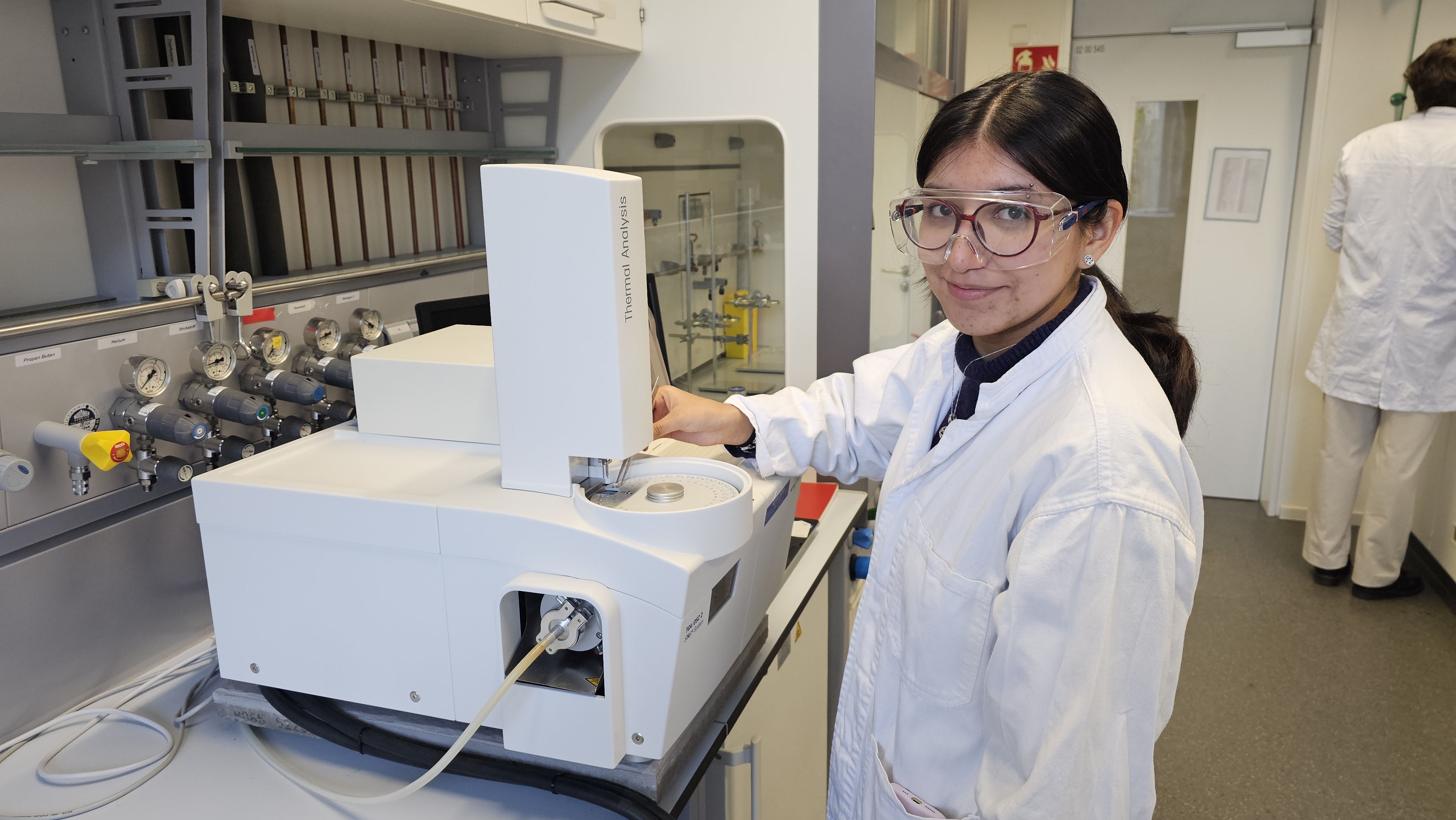
The aim is to gain a better understanding of the relationships between material composition, production and the resulting properties. Depending on the research question, different analytical methods can be employed. Thermogravimetric analysis (TGA), for example, can be used to determine how the mass of a material changes when heated. Differential scanning calorimetry (DSC) provides information on thermal processes and reactions.
Fourier-transform infrared spectroscopy (FTIR) enables conclusions to be drawn about chemical bonds and functional groups. It can, for example, reveal which chemical changes occur during the thermal treatment of polymers. Electrochemical investigations, such as impedance spectroscopy (EIS), can be used to complement these methods. This technique allows the analysis of electrical and ionic resistances, as well as electrochemical processes. With suitable measurement set-ups, conclusions can also be drawn about the transport properties of the substances involved in the electrochemical reaction. Together, these methods provide important information for further materials development.
Martina Sanguino-Dueñas is currently also working on these issues. The student is undertaking her compulsory placement as part of her Bachelor’s degree in Materials Science Engineering at the Institut Universitaire de Technologie (IUT) Chalon-sur-Saône in France, at Rhein-Waal University of Applied Sciences.
During her placement, she is working in the hydrogen laboratory on the Kamp-Lintfort campus and gaining insights into various methods of material characterisation. Another part of her placement involves collaborating with the DTNW in Krefeld. There, she is learning about the electrospinning process and gaining insights into the production and further development of nanofibre nonwovens.
The combination of material production and subsequent analysis enables her to examine scientific questions from different perspectives: How do production conditions influence the properties of a material? What changes result from thermal or chemical treatment? And which properties are crucial for subsequent use in electrochemical applications?
The collaboration between the DTNW and Rhein-Waal University of Applied Sciences brings together different scientific expertise and creates new opportunities for the investigation of innovative materials. At the same time, it demonstrates how regional research collaborations and international scientific exchange can complement one another. The sharing of specialist knowledge, methods and laboratory infrastructure yields valuable insights for the further development of materials that could be used in hydrogen technology in the future.