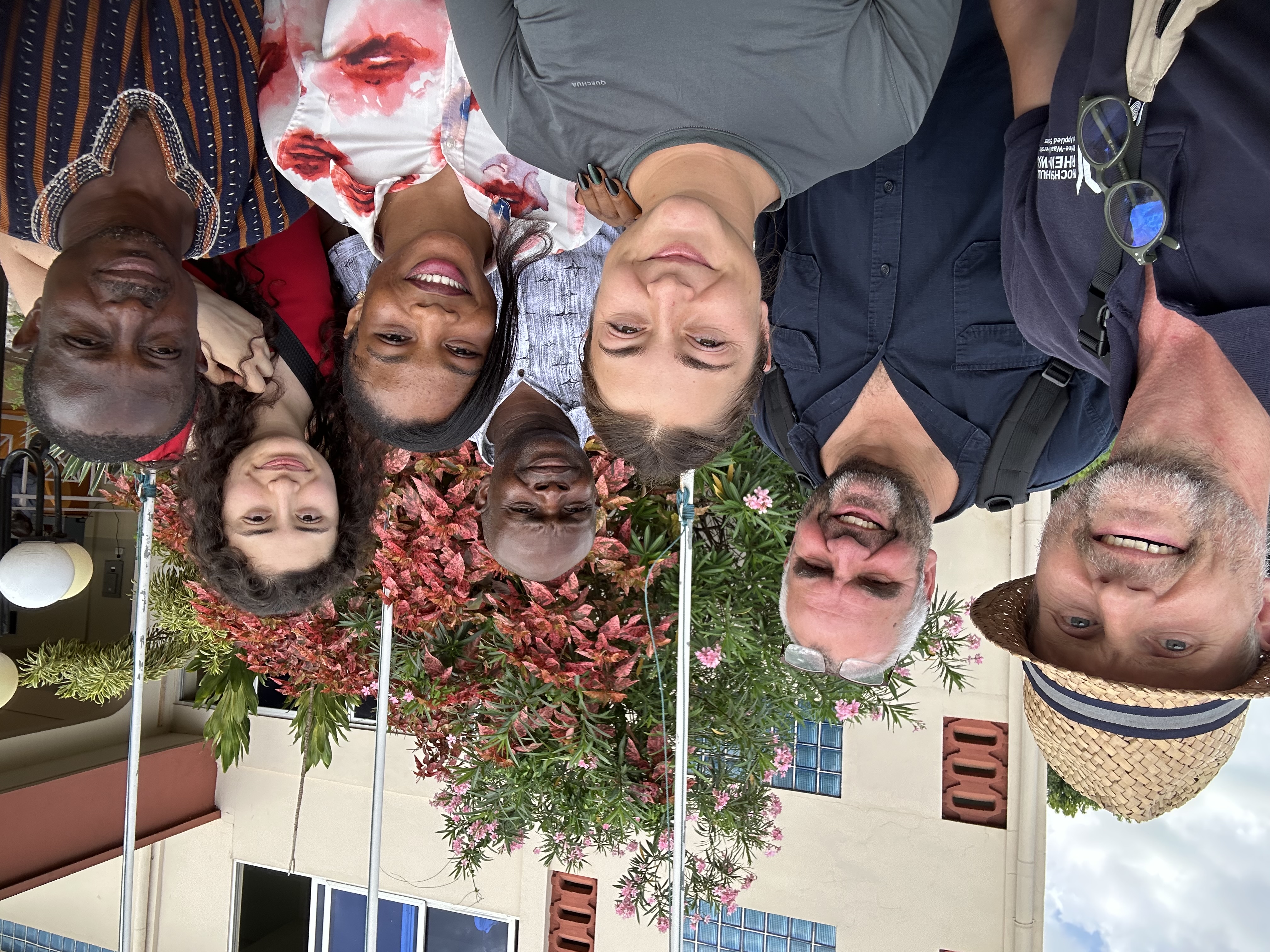
Together on the road: the team from Kleve and Ho. Photo: Prof. Dr. Jens Gebauer
Tree by tree: From the Kleve Tropical House to Ghana
How many baobabs grow in Ghana, and where are they? Ho Technical University and Rhine-Waal University of Applied Sciences want to find out – with the Faculty of Life Sciences involved.
One metre thirty. That is the height at which the tree mapping and inventory team wraps the measuring tape around the trunk, whether the baobab is young and slender or old and massive. First, someone holds a smartphone against the bark and an app records the GPS position. Then a photo. And if people from the village are nearby, the team asks: What do you use the tree for?
For two days, Prof. Dr. Matthias Kleinke and Prof. Dr. habil. Jens Gebauer, together with students Alma Onnis and Marene Amor, joined these measuring trips through the Volta Region in eastern Ghana. They did not take measurements themselves. They wanted to see how their colleagues in Ghana work: “how the baobabs are located, measured, entered into a data system and how the data are processed,” says Kleinke.
Position first: an app records the GPS coordinates for every tree. Photo: Prof. Dr. Matthias Kleinke
Measurements are always taken at one metre thirty, even when the tree stands in thick undergrowth. Photo: Prof. Dr. Matthias Kleinke
Ghana has plenty of baobabs. “But relatively little is known about how they are distributed and what impact their use has,” Kleinke explains. The BAOMAP project aims to change that. Where are the large stands? Where are young trees growing back, and where not? And what do people in different parts of the country use their baobabs for?
The project is led by Ho Technical University (HTU) and Prof. Dr. Kenneth Fafa Egbadzor. The Plant Genetic Resources Research Institute of Ghana’s Council for Scientific and Industrial Research (CSIR) is also involved. Funding comes from the Ministry of Culture and Science of the German state of North Rhine-Westphalia, which supports cooperation between universities in NRW and Ghana.
Measurements are taken all over the country, by staff of the participating institutes and by external mappers from the regions. Around Ho, most of them are Master’s and doctoral students at HTU. Aerial data such as satellite images are added. The result will be an online atlas.
For the villages themselves, the atlas will not change much at first, Kleinke admits. People there look after their own tree. The atlas is meant for the bigger question: “What matters is understanding how the stands develop in a changing environment and what can be done to stop their decline.” That is about nature conservation, but also about income. Where no young trees grow back, there will eventually be no fruit left to sell.
On the rock: many baobabs in the Volta Region grow on granite outcrops. Photo: Prof. Dr. Matthias Kleinke
Visible from afar: an old tree on the rocky ridge at the edge of the village. Photo: Prof. Dr. Matthias Kleinke
On the way to the next tree. Photo: Prof. Dr. Matthias Kleinke
Looking up the trunk into the crown. Photo: Prof. Dr. Matthias Kleinke
Ten days in Ho: campus, conference, villages
Besides the field trips, the programme included the university itself and several events. The largest was the FATAS conference (Food, Agriculture, Technology and Sustainability) on sustainable food systems. Before it, there was a separate project meeting on BAOMAP. The project was presented, and participants discussed where it stands and how it should continue.
Bringing two students along was deliberate. “We want to give our students the chance to be involved in international projects and to write their theses there as well,” says Kleinke. Both study Sustainable Agriculture. Marene Amor is planning her bachelor’s thesis on the flowering and pollination of the baobab, supervised jointly by both universities.
In the middle of the village: in the Volta Region, many baobabs stand between the houses, and people look after “their” tree. Photo: Prof. Dr. Matthias Kleinke
Marene Amor and Alma Onnis study Sustainable Agriculture at HSRW. Photo: Prof. Dr. Jens Gebauer
At the FATAS conference at HTU. Photo: Prof. Dr. Jens Gebauer
What does it feel like to stand in front of such a tree? Kleinke is not one for questions about feelings. He prefers to answer with observations. The old trees impress through their sheer bulk. What surprised him were the flowers: “It’s like a round pompom that looks rather bizarre and only blooms for one night.” Anyone who wants to see one has to set off in the dark, in the evening or early in the morning. Pollination also has to happen during that single night. Which animals are involved has not been fully established: fruit bats are considered likely, but other animals may also play a part. Marene Amor wants to write about exactly this and was glad to see the trees where they actually grow.
The two were accompanied by Ghanaian students who showed them the work on site. How that felt, you would have to ask the two of them, Kleinke says. What he did notice was that there was a lot of talking: “The young people exchanged ideas.”
“Like a round pompom”: the baobab flower opens for one night only. Photo: Prof. Dr. Jens Gebauer
Not only at night: bees on a baobab flower that has finished blooming. Photo: Prof. Dr. Matthias Kleinke
Fruit, oil, medicine: a versatile tree
The baobab that grows in Ghana is the African baobab (Adansonia digitata). It belongs to the mallow family (Malvaceae) and is one of several baobab species, most of which are found in Madagascar. It is widespread in the dry regions south of the Sahara. Almost every part of it can be used. The vitamin-rich fruit pulp is made into juice or ice cream, the seeds are pressed for oil and the bark is used for medicine. The leaves are brewed as tea or added to soup.
In many villages, the baobab stands at the centre. It is a meeting place and has spiritual meaning for people; Kleinke compares it with the village linden tree in Germany. Because it stores water in its trunk, elephants like it too. During severe droughts they eat the bark and hollow out the trunk.
Baobab has now reached Europe as well, as a powder in smoothies, snack bars or chocolate. Almost all of the fruit comes from wild trees.
This is where it gets difficult. “Who plants a tree that only pays off after decades?” Kleinke asks. Wild baobabs often bear fruit only after many years. If demand rises and nobody replants, the stands shrink.
In Ho, Egbadzor is working on turning the baobab into a cultivated crop. His team grafts a shoot from an older tree that has already borne fruit onto young plants. These grafted trees flower and fruit after around two to three years. The next question is which combinations make this possible and how to propagate them. Kleinke sees this as the lever for the villages: people who harvest sooner are more likely to plant trees themselves.
It will not be easy, because baobabs vary greatly in their genetics. “You have five to seven trees standing next to each other, and four of them look completely different,” says Kleinke. Long fruit, round, thick, thin. Some trees bear fruit early, others late.
Young trees already bearing fruit. Photo: Prof. Dr. Matthias Kleinke
The fruits hang on long stalks. Photo: Prof. Dr. Matthias Kleinke
Many uses for the baobab: on the sidelines of the conference on sustainable food systems (FATAS) at Ho Technical University, exhibitors present regional products – including wine made from baobab fruit. Photo: Prof. Jens Gebauer
From Sudan to the Lower Rhine
Why would a university in Kleve, of all places, work on this tree? Kleinke is candid: without Jens Gebauer, nobody in Kleve would probably have thought of the baobab. Gebauer, Professor of Sustainable Agricultural Production Systems, brought the topic with him. Before coming to Kleve, he had already researched the baobab in Sudan. “The baobab has always fascinated me,” says Gebauer. “It is an extraordinary and captivating tree whose appearance and characteristics impress me again and again.”
This grew into a research focus at the faculty with many people involved. The BAOFRUIT (2015 to 2016), BAOFOOD (2016 to 2019) and BAOQUALITY (2019 to 2022) projects looked at how the baobab can contribute to nutrition in Africa. By the way, there are baobabs in Kleve too, in the tropical house on campus, which Gebauer manages. They would not stand a chance outdoors because they cannot tolerate frost. “Though who knows, in 50 years,” Kleinke says with a laugh.
Kleve and Ho have been working together for years. Through a DAAD exchange programme and an Erasmus+ project, students, lecturers and delegations have travelled in both directions. The Faculty of Technology and Bionics supported HTU in setting up its FabLab, an open workshop for digital fabrication. It opened in 2024 as the first at a public university in Ghana.
At the Faculty of Life Sciences, the cooperation centres on the baobab. Kleinke and Egbadzor have already published together, most recently at the 2025 Tropentag conference in Bonn.
In Ho, the team has already discussed a follow-up project. It is to investigate what lies behind the genetic diversity of the trees. How it could be funded was also on the agenda. For BAOMAP itself, Kleinke deliberately keeps expectations modest: “The idea that every baobab in Ghana could be measured and mapped within six months might be a rather bold approach.” Still, he says, the project has got off to a very good start. Until the end of the year, the measuring will continue, tree by tree, at one metre thirty.
A meeting place: there is room for everyone under the tree. Photo: Prof. Dr. Matthias Kleinke
Between the houses, the baobab is part of the village scene. Photo: Prof. Dr. Matthias Kleinke
Behind the huts stands another old tree. Photo: Prof. Dr. Matthias Kleinke
The baobab as a motif: a painted village tree. Photo: Prof. Dr. Matthias Kleinke