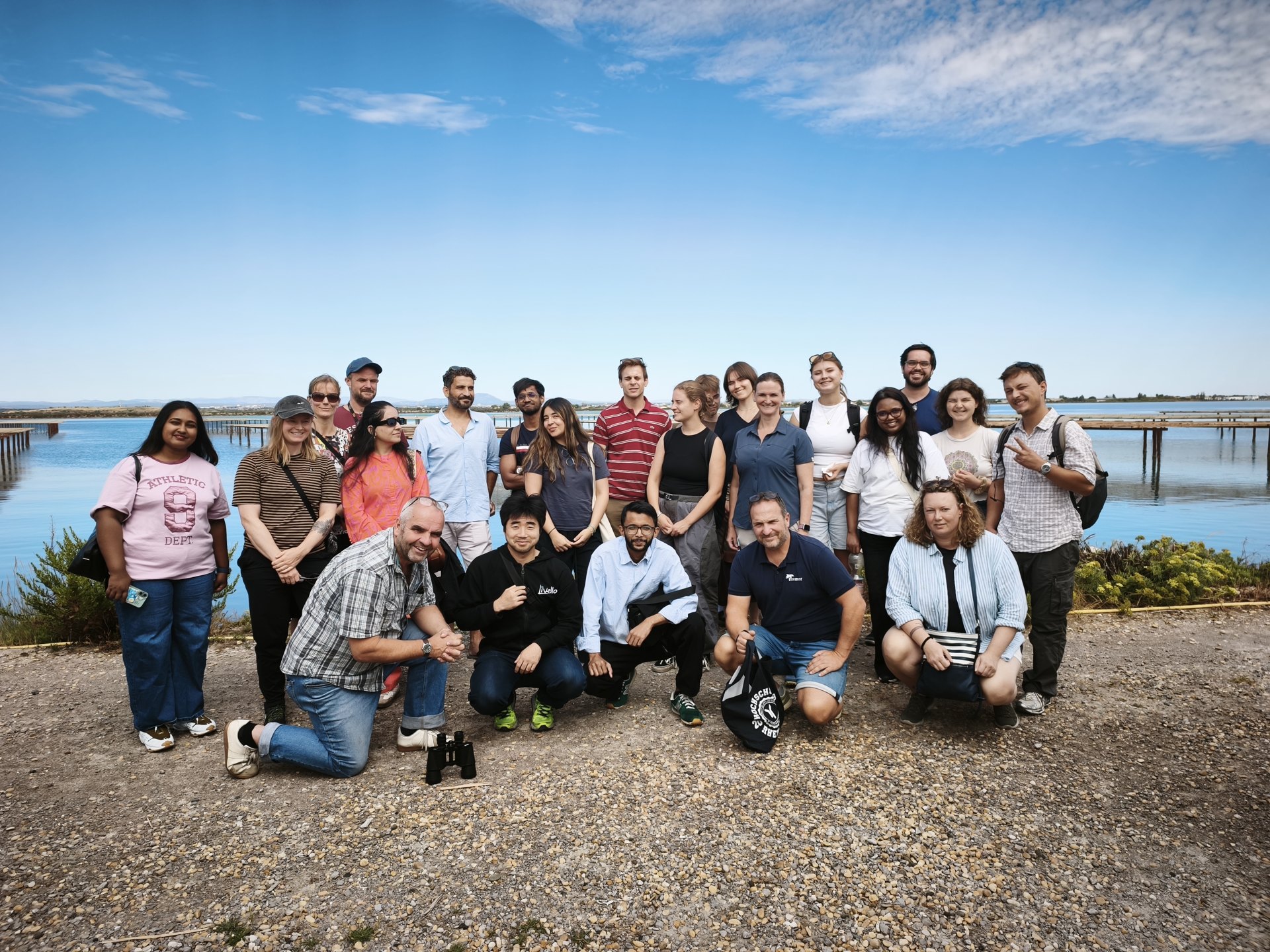
23 students from twelve countries and their lecturers on the Mediterranean coast near Palavas-les-Flots. Photo: Prof. Dr. Matthias Kleinke
2,200 km of practice: on the road with the Faculty of Life Sciences
Three minibuses, 23 students from twelve countries, more than 2,200 kilometres: in September, the Faculty of Life Sciences travelled from Lorraine to the Camargue.
Along the way, the trip looked at how fruit, mustard seed and grapes become a finished product – and at what it is like to share a kitchen for a week with people from twelve countries.
In the middle of the night, something howls outside. A high-pitched, piercing sound cuts through the dark fields surrounding the Le Moulin group house in Montfrin, southern France – somewhere between the sound of a jet aircraft and a combine harvester. “But there was nothing out there to mow,” says Matthias Kleinke, Professor of Environmental Engineering at Rhine-Waal University of Applied Sciences, and laughs. The next day, the mystery is solved: two hundred metres from the accommodation lies a winegrower’s estate, surrounded by vines. It is mid-September, the grape harvest is in full swing, and harvesting continues even in the dark.
A few days later, the students will be sitting on top of these machines themselves. But first things first.
“Understanding comes from grasping”
Anyone taking part in this field trip is doing so voluntarily. There are no ECTS credits, no compulsory attendance as in a laboratory practical, and no mark at the end. Nevertheless, 23 students boarded the university’s three minibuses during the semester break. For excursion leader Kleinke, trips like this are at the heart of a university of applied sciences. “Understanding comes from grasping – „Begreifen kommt von Greifen“, as the German saying goes,” he says. “You have to have seen things to truly internalise them.”
The university’s first international agricultural field trip took place in this region of France some fifteen years ago. Since then, the trips have mostly been to Eastern Europe – to Poland, Romania, the Czech Republic, Russia or Kyrgyzstan – in other words, to places that don’t feature on anyone’s holiday list. In the Polish Carpathians, for example, participants could see how calmly the farmers there deal with wolves. Last year, the group even travelled as far as Benin in West Africa.
Following that long-distance trip, the plan this time was to travel without flying, using the university’s own coaches and the available budget. France was also a suitable choice from an academic perspective. The route to the Mediterranean takes you through landscapes that have little in common with the Lower Rhine, and the stops can be arranged to illustrate the entire value chain: from cultivation in the fields through industrial processing to sale at the market.
Three minibuses, 23 students from twelve countries: in September, the Faculty of Life Sciences’ agricultural field trip ran from Lorraine to the Camargue. Photo: Prof. Dr. Matthias Kleinke
Mirabelle plums, voles and paperwork
The tour begins in Lorraine, near Metz. The region accounts for around 70 per cent of the world’s mirabelle plum harvest. A small family-run farm grows the fruit here and uses it to make its own brandy, wine and jam. What the group hears on the farm isn’t found in any promotional brochure. The dry summers are taking their toll on the trees, voles are causing damage in the fields, and the paperwork from the European agricultural authorities is piling up in the office. An excursion is simply “not a pleasure trip”, says Kleinke. The aim is to see the farms as they really are.
“It was incredibly moving when the owner said that she actually doesn’t want her children to take over the farm,” says Björn Flockau, who coordinates academic exchanges at the faculty and helped organise the tour. “You could sense how much it pained her. And at the same time, she is well aware of the harsh reality of her daily work.”
Lorraine accounts for around 70 per cent of the world’s mirabelle plum harvest. The group in the orchard of a family-run farm near Metz. Photo: Prof. Dr. Matthias Kleinke
Mirabelle plums shortly before the harvest. Dry summers are putting increasing strain on the trees. Photo: Prof. Dr. Matthias Kleinke
Group photo at the Distillerie de Mélanie: 23 students from twelve countries spent a week on the road. Photo: Prof. Dr. Matthias Kleinke
The farm shop sells home-made brandy, wine and jam. Photo: Prof. Dr. Matthias Kleinke
Mustard made from Canadian seeds
The next day brings the second link in the chain: large-scale processing. Kleinke had specifically requested the stop in Burgundy. “Everyone knows Dijon mustard,” he says, “but seeing how agricultural produce is transformed into the finished product in industrial food production is an experience in a class of its own.” At Reine de Dijon in Fleurey-sur-Ouche, a few kilometres west of the city, the group takes a tour of the production facilities. Afterwards, the itinerary takes them to La Maison Maille in the city centre, the flagship shop of this long-established mustard brand.
Here, they also learn that, when it comes to mustard, ‘Dijon’ refers to a recipe rather than a designation of origin. Around 80 per cent of the mustard seeds required by French manufacturers come from Canada. Only for ‘Moutarde de Bourgogne’ must the seeds come from Burgundy. In this case, therefore, the supply chain the group is following begins on another continent.
After two nights in Dijon, the coaches continue southwards.
Second stage of the value chain: the group at the industrial mustard production of Reine de Dijon in Fleurey-sur-Ouche. Photo: Prof. Dr. Matthias Kleinke
With mustard, “Dijon” is a recipe, not an indication of origin. Around 80 per cent of the mustard seed comes from Canada. Photo: Prof. Dr. Matthias Kleinke
Mustard shelves at La Maison Maille in central Dijon, the flagship store of the long-established brand. Photo: Prof. Dr. Matthias Kleinke
A kitchen for everyone
In Montfrin, the group has taken up residence in a self-catering house for financial reasons. Frieda Rogowski, who is in her fifth semester studying Sustainable Agriculture, initially appreciates the practical side of things: “It cuts down on the hassle enormously; you don’t have to pack your suitcase every morning.”
But the kitchen is becoming even more important. The 23 students come from twelve countries; they are in their first to ninth semesters, studying for a Bachelor’s or Master’s degree, and there are also a few guests from other faculties. Every evening, a different, diverse team cooks for around thirty people. There are vegetarian, vegan, halal and meat-based options, and everyone is meant to be well fed. Rogowski searches in vain for her usual yeast flakes in the French supermarket, whilst lecturers who otherwise enjoy eating meat help themselves to the vegan dish as a matter of course. “We’ve found solutions there with a great deal of consideration and openness, and it’s always tasted good,” says Kleinke. However, he adds with a smile, there have been “very different levels of efficiency in the process”, “from shopping to laying the table. Sometimes it takes a bit longer, and sometimes it’s done in a flash.”
Rogowski shares her room with fellow travellers from Israel and the US. “At uni, this is sometimes only touched upon briefly; you might be asked where you’re from or what food you’ve brought with you,” she says. “But when you share a room for a week with people from a completely different continent, you become much more aware of the differences and similarities than when you’re just sitting next to each other in a lecture.”
The group’s accommodation: the self-catering house Le Moulin in Montfrin, southern France. Photo: Prof. Dr. Matthias Kleinke
Every evening a different team cooked for around thirty people – vegetarian, vegan, halal and with meat. Photo: Prof. Dr. Matthias Kleinke
Table tennis in the courtyard of the group house in the evening. Photo: Prof. Dr. Matthias Kleinke
Research on the Mediterranean
What begins in the kitchen in the evening continues during the day with visits to specialist sites. On Thursday, after a stop at the Roman aqueduct bridge, the Pont du Gard, the group travels to Montpellier to visit CIRAD, the French Centre for Agricultural Research for International Development. On Friday, they visit the experimental station of the marine research institute IFREMER in Palavas-les-Flots, right on the coast. The focus there is on fish farming and marine conservation. Afterwards, the group visits Maguelone Cathedral and the vineyards surrounding it.
On such visits, agricultural students find themselves alongside fellow students from engineering and the social sciences, and each group asks different questions. “At first, people wonder: ‘What on earth are those from the other degree programme doing here? And suddenly they’re having cross-disciplinary discussions about social and technical interrelationships,” says Kleinke. Background also plays a part, adds Flockau: “Someone who grew up in Israel or Mexico has a completely different perspective on production processes in France than someone who grew up in Germany.”
A stop at the Roman aqueduct bridge Pont du Gard. Photo: Prof. Dr. Matthias Kleinke
A visit to CIRAD in Montpellier, the French agricultural research centre for international development. Photo: Prof. Dr. Matthias Kleinke
In the CIRAD laboratory. Photo: Prof. Dr. Matthias Kleinke
From the CIRAD collection: maize varieties from around the world. Photo: Hochschule Rhein-Waal
The group on the CIRAD site in Montpellier. Photo: Prof. Dr. Matthias Kleinke
Guided tour of the CIRAD research facilities. Photo: Prof. Dr. Matthias Kleinke
Fish in the breeding tanks of the research station. Photo: Prof. Dr. Matthias Kleinke
Maguelone Cathedral, surrounded by vineyards. Photo: Prof. Dr. Matthias Kleinke
On the grape harvester
On Saturday, it’s the winemaker’s turn – the very man whose machines kept the group awake all night. Students and lecturers climb onto the roaring grape harvesters and ride along through the rows of vines. “We were allowed to ride along on the harvesters and saw first-hand how the grapes, fresh from the vineyard, were crushed and pressed,” says Flockau. The estate isn’t a top-tier winery; here, regional wine is produced mechanically and without much fuss. That’s precisely why the insight is so unvarnished: the harvest and processing take place just a few hundred metres apart.
Rogowski hadn’t expected much from it. “I actually used to think wine production was quite boring,” she admits. “But then it turned out to be really fascinating to watch the different stages of fermentation and to taste the wine. And riding along on those huge, monstrous grape harvesters was pretty cool.”
That leaves the final link in the chain: sales. Also on Saturday, the group heads to the weekly market in Arles, one of the largest in Provence.
In mid-September the grape harvest is under way in southern France. Photo: Prof. Dr. Matthias Kleinke
Grape harvesters in the rows of vines. Students and lecturers were allowed to ride along on the machines. Photo: Prof. Dr. Matthias Kleinke
A look inside the shaking mechanism of a grape harvester. Photo: Prof. Dr. Matthias Kleinke
Freshly harvested grapes are crushed – here, harvesting and processing are only a few hundred metres apart. Photo: Prof. Dr. Matthias Kleinke
In the neighbouring winery’s cellar: fermentation tanks and the various stages of fermentation. Photo: Hochschule Rhein-Waal
The final link in the chain: the weekly market in Arles, one of the largest in Provence. Photo: Prof. Dr. Matthias Kleinke
A market stall in Arles. Photo: Prof. Dr. Matthias Kleinke
Rice alongside flamingos
On Sunday the group heads into the Camargue, to the Maison du Riz near Albaron – a small museum dedicated to rice cultivation in the Rhône delta – and on to the Regional Nature Park. There, rice fields border nature reserves where flamingos stand and white Camargue horses graze. Here, agriculture and nature conservation have to coexist within a confined space. “At the faculty, we don’t just study agriculture; we always consider land use against its cultural and natural backdrop,” says Kleinke.
On Monday morning, the long journey home begins via Metz, with a few boxes of wine from a neighbouring winegrower in our luggage. We have a flat tyre on the way, but spirits remain high. Around 10 pm, the buses roll into the campus in Kleve.
It’s a huge undertaking, both organisationally and financially, and funds are tight. So why do we keep doing it? “If someone is following my lecture, I don’t mind if they’ve forgotten the fourth or sixth session at some point,” says Kleinke. “But I remember exactly what stands out from my own student days: it’s the field trips. Our ultimate goal is for the students to still have fond memories of this week, even thirty years from now.”
The Maison du Riz near Albaron, a small museum about rice growing in the Rhône delta. Photo: Prof. Dr. Matthias Kleinke
A rice field in the Camargue. Photo: Prof. Dr. Matthias Kleinke
The rice harvest in the Rhône delta. Photo: Prof. Dr. Matthias Kleinke
In the regional nature park, rice fields border reserves where flamingos stand. Photo: Prof. Dr. Matthias Kleinke
In the Camargue, farming and nature conservation have to coexist in a confined space. Photo: Hochschule Rhein-Waal