
Over the next few years, the AgroHeat project will develop and implement a method for controlling fungal diseases. Partners from the fields of research, agriculture, horticulture and engineering are involved in the project.
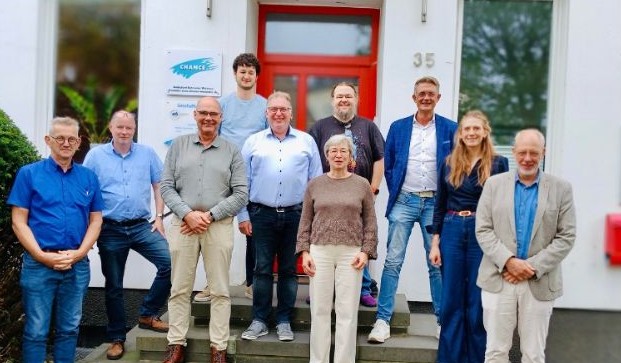
Over the next few years, the AgroHeat project will develop and implement a method for controlling fungal diseases. Partners from the fields of research, agriculture, horticulture and engineering are involved in the project.
As part of the cross-border AgroHeat project, researchers, mechanical engineering firms and commercial farms from Germany and the Netherlands are jointly developing a non-chemical, physical method for controlling fungal diseases in open-field cultivation. The method utilises a short-term, precisely controlled microclimate consisting of heat, hot water mist and UV light, which is generated in the field beneath a mobile canopy and damages fungal spores without harming the plants.
The aim is to develop six machine variants, which will initially be tested on onions, parsley and chives and mounted on tractors or agricultural robots. Rhein-Waal University of Applied Sciences is responsible for the scientific analysis of the technical and agronomic factors, the sensor and control concepts, the energy and thermal engineering analysis, and the scientific supervision of the prototype tests. The project contributes to the reduction of plant protection products, sustainable agriculture and smart farming.
The Interreg project comprises the lead partner dnlcontact, as well as Rhein-Waal University of Applied Sciences (represented by Prof. Dr.-Ing. Dirk Nissing), acesenergybatteries, Friedrich Schulz Gartenbau GmbH & Co. KG, HOAF, marktclimatechnology, Mercatronics GmbH and VNK Herbs.