
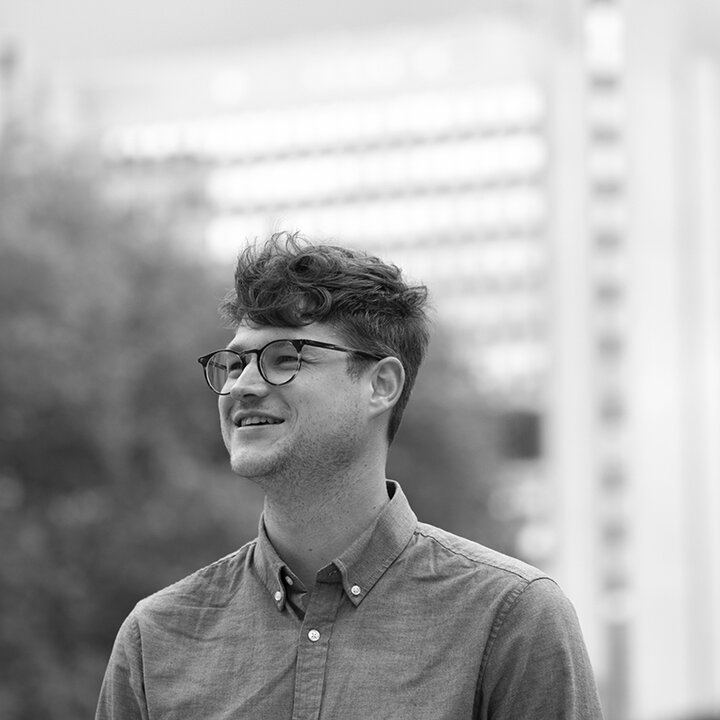
Prof. Dr. Matthias Laschke
Contact
When I’m in the office, I follow an open-door policy—feel free to drop by. As I’m not always around due to teaching and other commitments, please contact me by email for planned meetings or matters that require preparation.
Kamp-Lintfort Campus
Friedrich-Heinrich-Allee 25, 47475 Kamp-Lintfort
Contact in Faculty of Communication and Environment
Kamp-Lintfort Campus
Friedrich-Heinrich-Allee 25, 47475 Kamp-Lintfort
Profile
Matthias Laschke is Professor of Digital Media Design at Rhine-Waal University of Applied Sciences. As a design researcher, his work focuses on the design and study of interactive artifacts and their significance for human experience, behavior, and societal transformation. His current research interests include post-anthropocentric design and human–nature relations, sustainable behavior change, Experience Design, and interaction with autonomous artifacts (i.e., “Otherware”). Increasingly, his research also addresses the role of design in a post-growth society.
In recent years, his work has addressed sustainable everyday practices, motivation and the internalization of behavior, humor and friction as design strategies, procrastination and willpower, treatment adherence, work motivation, as well as autonomous and learning artifacts. Methodologically, he combines empirical research with design research approaches such as Research through Design, Design Fiction, Critical Design, and Speculative Design, as well as ethnographic and autoethnographic methods. A particular interest lies in how design itself can contribute to the generation of scientific knowledge. He currently leads the BMBF-funded junior research group MOVEN.
Laschke regularly publishes on these research and design topics at international conferences and in peer-reviewed academic journals. His work has also been featured and discussed in Evgeny Morozov’s To Save Everything, Click Here, the New York Times, Wired, and Fast Company, as well as at the R&D Salon of the Museum of Modern Art in New York. One of his works is part of the permanent collection of the Deutsches Museum.